

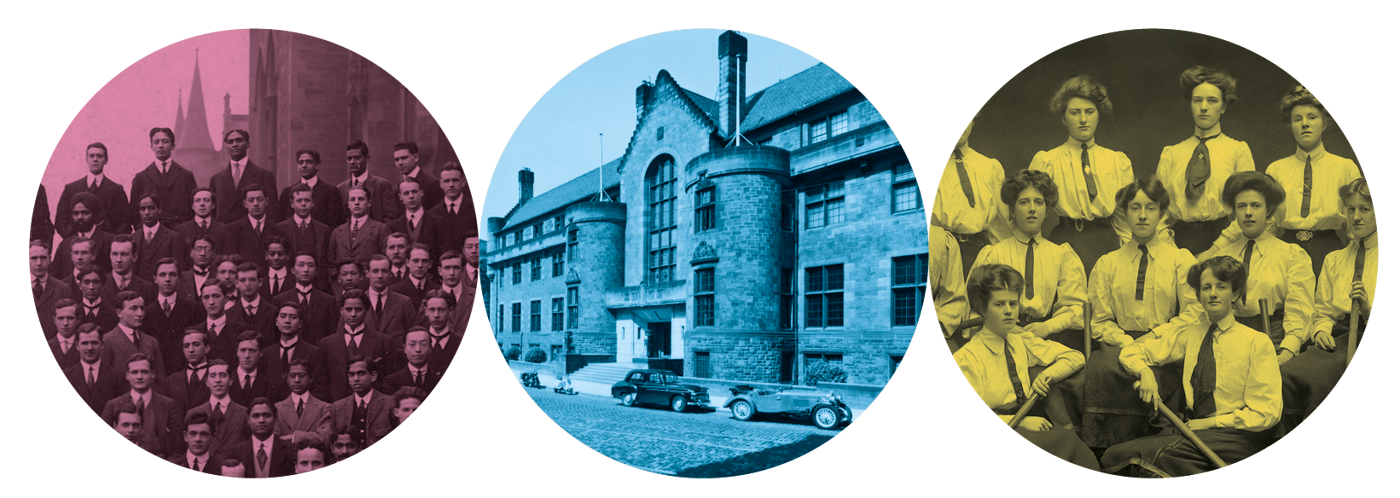
About the exhibition
Glasgow Makes People - From March 26th
"The Pearl of Knowledge"
The University of Glasgow was founded by Pope Nicholas V on 7 January 1451.
Writing to the city’s Bishop, he desired that “by assiduous study “the pearl of knowledge”, would show the city the way to “live well and happily”.

A 2001 copy of the Papal Bull of foundation
In its earliest years, the University was a small community of four teachers and just ten to twenty students, some as young as ten years old. Education was limited to a select elite who studied in and spoke Latin, the shared language of scholarship across Europe.
University life was also deeply religious, with scripture reading and prayer at its heart. Teachers and students would attend church together twice every Sunday and ate together at a ‘common table’, reinforcing a close-knit academic and spiritual community

Fifteenth-century choir singing. The sort of ecclesiastical setting in which the University was founded. MS Gen 288
"The Vig’rous Youth Commence"
From 1560 to 1690 the University underwent major change. Fundraising for new accommodation took place amid religious and political turmoil, and state-of-the-art facilities in a quadrangle layout were completed in 1690. By 1702, the “Old College” (as the University on the High Street became known) housed 400 students, with live-in accommodation for 40 and others boarding nearby.

University of Glasgow student pictured in typical red gown in this nineteenth-century watercolour. MS Murray 593
Official records rarely show individual students’ perspectives. Our understanding of University life comes largely from sources left by professors, which reveal their views on how a Glasgow student should live and learn.

University as it looked in the late seventeenth-century, viewed from High Street looking East, with the College Garden to the rear. Drawn by John Slezer. Sp Coll Bi8-a.1
“A New and Splendid Edifice”
Nineteenth-century Glasgow was the self-confident “second city of the Empire”, with a vibrant economic and cultural life. New educational approaches emerged to meet the challenges of the industrial age. The professors sold the Old College site to make way for the growing railway network and to fund campus expansion. They chose the fresh air of Gilmorehill in the west end to escape the city centre pollution which had impacted University life for decades.

New University buildings on Gilmorehill viewed from the west. Tennis courts are visible in the foreground. PHU1/46i
On the High Street campus, societies dedicated to academic, social and political pursuits were well established, meeting in the many taverns and venues in the city centre. The move to Gilmorehill transformed this arrangement. New university spaces now had to accommodate teaching, meetings, public lectures and ceremonial events, leaving student societies to compete for room within an increasingly complex campus timetable.
In 1885, students and alumni gathered in the Bute Hall to find a way forward.
“To Promote Social and Academic Unity”
Glasgow University Students’ Representative Council first met on 9 March 1886.
Its foundational aims were “to represent the Students in such matters as affect their interests, to afford a recognised means of communications between Students and the University authorities and to promote social and academic unity among the Students.”
At its inaugural meeting, Robert Mark Wenley was elected the first President. Wenley later became Professor of Philosophy at the University of Michigan and was awarded an honorary degree by the University of Glasgow in 1901, during its 450th anniversary.

Minute of the meeting where the first members of the SRC were elected, 9 March 1886. DC147/4/1
