

Elections 2026
As we look ahead to elections across the UK in Spring 2026, access insights and evidence from University of Glasgow experts, to inform and contribute to the conversation.
Contact us
Contact the Centre for Public Policy team at public-policy@gla.systa-s.com.
Sign up to the Centre for Public Policy mailing list

New UofG Spotlight series: On the elections
- Episode 1: The Polls and the Policies So Far
- Episode 2: An Election in the Shadow of War?
- Episode 3: The Rise of the Right
- Episode 4: The Manifestos
- Episode 5: Can the Next Scottish Government Revive the Economy?
- Episode 6: Can the Next Scottish Government Fix Public Services?
- Episode 7: In England and Wales
- Episode 8: Power, Policy, and the Next Five Years

Live webinar series - watch the recordings
- What just happened? Unpacking the election results Monday 11 May, 1-2pm
- Does Scottish independence still matter to voters? Thursday 30 April, 12-1pm
- What are the parties' plans on tax, spending and the economy? Monday 27 April, 1.30-3pm
- What can devolved governments do to address the cost-of-living crisis? Tuesday 21 April, 1-2pm
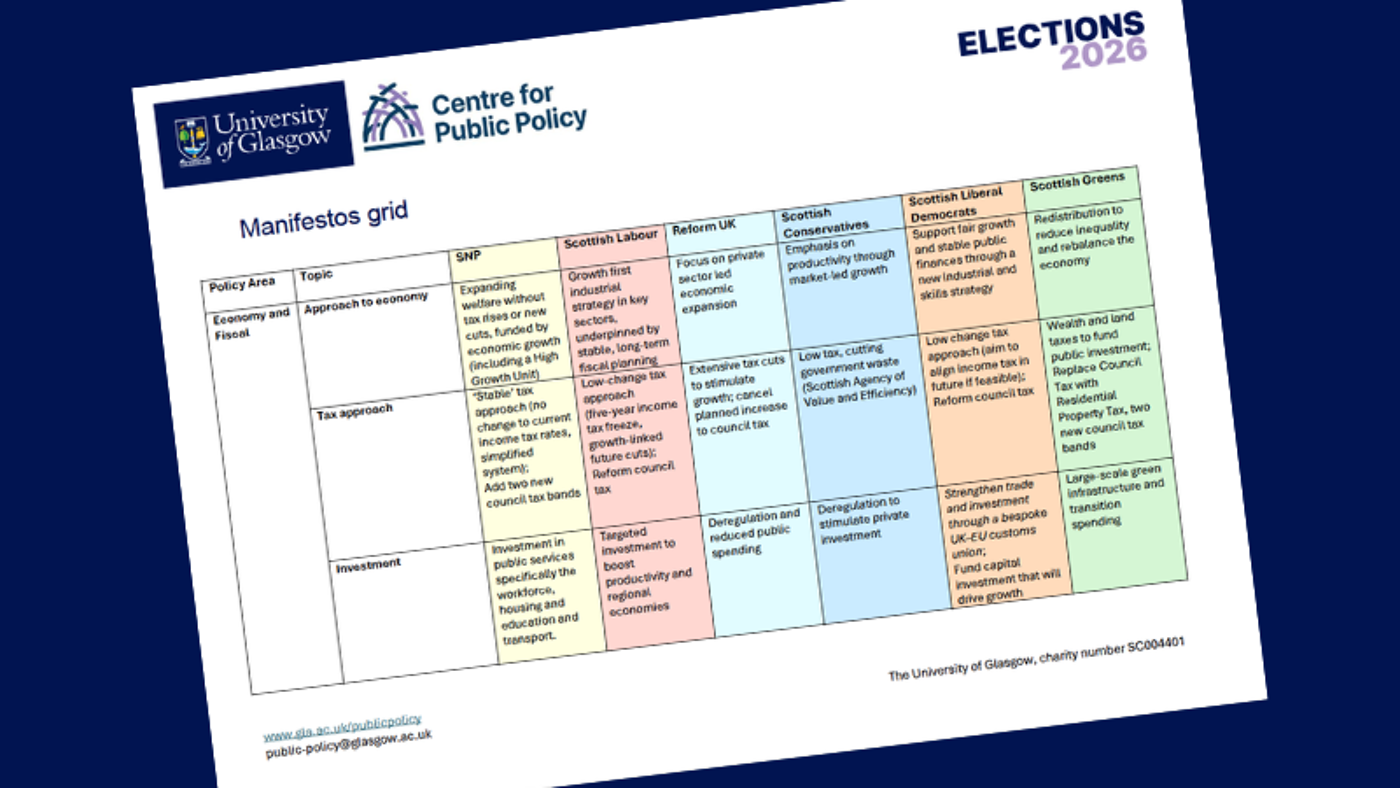
Scottish party manifestos analysis
What do the party manifestos say on the big topics facing Scotland?
Access the Centre for Public Policy's suite of manifesto analysis for insights on what each party pledged in key policy areas, where we might see collaboration opportunities and challenges across the parties.
- Read and download the manifestos analysis grid
- Read and download briefing papers analysing the manifesto pledges on key policy themes
Manifesto analysis by policy theme
Energy
Read and download this manifesto analysis on Energy as a PDF:
Scottish manifesto analysis: Energy
Key takeaways:
- There is substantial overlap across parties on expanding Scotland’s renewable capacity, with SNP, Labour, Liberal Democrats and Greens all backing major growth in offshore wind, grid upgrades, home energy improvements and worker transition schemes, creating scope for post election cooperation on practical delivery of the energy transition.
- Most parties acknowledge the need to cut household energy costs, reflected in SNP community energy investment; Labour’s efficiency and ownership plans; Conservative bill discounts from Crown Estate revenues; Liberal Democrat emergency insulation; and Greens’ support for heat pumps and home upgrades. This signals shared ground on the need to tackle energy affordability. However, the approaches differ notably, suggesting potential challenges in cross-party consensus.
- A clear party split lies in the role of fossil fuels and Net Zero. SNP, Labour, Liberal Democrats and Greens prioritise accelerated renewables and managed transition, while Reform UK and the Conservatives emphasise expanded oil and gas, scrapping Net Zero targets and scaling back renewable subsidies, a split between sustainable energy led and fossil fuel led energy strategies.
SNP
Key policies:
- Devolve energy powers to Holyrood
- £500m Just Transition Fund for workers and businesses making the change to a sustainable future
- Ringfence at least £100m of ScotWind revenues for community owned energy projects
- 500 new jobs in Grangemouth industrial cluster, £9m to Mossmorran
- Expand the Community and Renewable Energy Scheme (CARES) to £15m
Summary and analysis:
The SNP’s 2026 manifesto presents a climate and energy strategy centred on accelerating the transition to net zero, lowering household bills, and increasing Scotland’s control over energy policy. It commits to expanding offshore wind, solar, pumped storage and emerging technologies, alongside warmer homes, a more resilient energy system, and an expanded Community and Renewable Energy Scheme. The party also sets out a Just Transition programme, including the £500 million Just Transition Fund, support for workers in the North-East and Grangemouth, and the creation of a ScotWind Wealth Fund to ensure future generations benefit from renewable revenues. Decisions on North Sea oil and gas are framed around a “rigorously evidence led, case by case” climate compatibility test, with energy security as a core consideration.
However, while the manifesto outlines broad ambitions, it provides limited detail on the delivery mechanisms required to meet them. Large scale renewable expansion, grid upgrades, and home energy improvements depend on planning reform, supply chain capacity, and workforce pipelines that are not fully specified. The Just Transition proposals rely on strong coordination across skills, industrial strategy and regional development, but governance arrangements are not clearly set out. A central argument is that devolving full energy powers would allow Scotland to cut costs faster and accelerate investment, yet the manifesto does not explain how short term system pressures—such as price volatility, grid constraints or transition costs—would be managed during the shift.
Scottish Labour
Key policies:
- Support new nuclear development
- Digital Skills Passports for offshore workers to move towards renewable jobs
- £40m funding for the North East energy transition
- Introduce a new Marine Plan for offshore wind by 2040
Summary and analysis:
Labour set out a climate and energy plan focused on economic regeneration and cutting emissions, including a clearer willingness to use new nuclear power as part of Scotland’s long term energy mix. They argue nuclear can help with energy security, but the manifesto does not go into detail about the long timescales, regulatory hurdles or funding challenges, or how this would fit with Scotland’s planning system.
Their wider plans for renewables, grid upgrades and home retrofitting would need a lot of delivery capacity from government, but the manifesto gives limited detail on how procurement, governance or workforce pipelines would be organised to make this happen at the same time.
Labour link their approach to a Just Transition, but they do not set out clearly how industrial strategy, skills policy and regional development would be coordinated, or how differences between regions would be managed.
They also aim to reduce bills through public ownership and energy efficiency, but the manifesto does not explain how short term pressures on the system would be handled while these long term changes are being put in place.
Reform UK (Scotland)
Key policies:
- Scrap all SNP Net Zero targets, subsidies and quangos
- New nuclear in Scotland
- Rehabilitate North Sea oil and gas as our primary energy system
- Simplifying planning system for energy infrastructure
- Scottish Energy Workforce Plan for colleges and apprenticeships
- Energy Price Impact Statement for every related policy decision
Summary and analysis:
Reform UK frame climate and energy policy around affordability, energy sovereignty, and opposition to Net Zero. They call for more North Sea oil and gas, fewer climate regulations, and reduced support for renewables. They also emphasise lower household bills, faster planning for energy projects, and prioritising economic competitiveness over emissions targets.
Analytically, this is a fossil fuel led approach that rejects Net Zero, but the manifesto does not explain how expanded North Sea extraction fits with global demand trends, investor behaviour or legal climate obligations. Scaling back renewable support raises questions about grid upgrades, investment certainty and Scotland’s ability to meet statutory targets, given how central renewables are to current planning. Their reliance on market led mechanisms and lighter regulation leaves unclear how quality, resilience and long-term system costs would be managed. The focus on affordability through deregulation also places less emphasis on efficiency, demand reduction or changes to transport and housing, limiting long term emissions reduction.
Scottish Conservatives
Key policies:
- Direct Crown Estate Revenues from wind projects to a direct £100 energy bill discount for households
- Protect funding for energy efficiency upgrades but redirect money from heat pumps to building homes and infrastructure
- Abolish SNP’s target for net zero by 2045
- Back the abolition of renewable energy subsidy schemes
- Abolish tax on oil and gas
- Scrap the Just Transition Fund and replace it with an Affordable Transition Fund
- Support new nuclear in Scotland
Summary and analysis:
The Scottish Conservatives set out an energy agenda centred on expanding domestic oil and gas production, accelerating nuclear development, and reducing regulatory barriers to new energy infrastructure. Their proposals emphasise energy security, affordability, and the role of Scottish-produced energy in lowering household bills. A key commitment is to return revenue from offshore wind auctions directly to households through a £100 annual bill discount. They also propose an Affordable Transition Fund rather than a Just Transition Fund and a commitment that new energy projects should proceed only where they have community support.
While the approach prioritises stability and lower bills, the manifesto provides limited detail on how major delivery challenges would be managed. Continued reliance on North Sea production assumes stable investment and regulatory certainty, but the manifesto does not explain how this aligns with long-term climate targets or future demand trends. Similarly, commitments to accelerate nuclear development require substantial investment and long-term planning, yet timelines and delivery structures are not fully set out. Proposals to cut bills depend on market led mechanisms and infrastructure upgrades, but there is little discussion of how grid constraints, planning delays, or supply chain pressures would be addressed.
Scottish Liberal Democrats
Key policies:
- Emergency insulation programme for homes
- Fairer Heating Bill for climate-friendly heating systems
- Oppose fracking and any attempts for new front of shale gas fossil fuels
- Move transport away from fossil fuels
- New nuclear in Scotland
- Giving local authorities the General Power of Competence for councils to further innovate around renewable energy
Summary and analysis:
Scottish Liberal Democrat energy policy is built around accelerating the transition to clean, affordable power through a combination of large scale infrastructure investment, planning reform and community benefit. Their manifesto positions renewable energy expansion, grid upgrades and home insulation as the primary levers for lowering household bills and improving energy security, while also expecting local authorities and communities to play a greater role in shaping and benefiting from new developments. These ambitions depend on rapid progress in planning, consenting and grid capacity, yet the manifesto provides limited detail on how these system wide bottlenecks will be addressed beyond broad commitments to modernisation.
The party emphasises a just transition for workers and regions currently dependent on oil and gas, but the operational mechanisms for retraining, industrial diversification and long term regional support are only partially specified. Their proposals to rewrite community benefit rules and reform ScotWind style processes signal a shift towards greater local returns, though the governance structures for distributing and managing these revenues are not fully outlined. Overall, the energy agenda sets a clear direction focused on affordability, renewables and community benefit, but the delivery architecture required to coordinate planning, workforce transition and infrastructure investment is less fully developed in the manifesto
Scottish Greens
Key policies:
- End new oil and gas extraction
- £600m investment in renewables (including offshore wind, tidal and solar)
- Bring back the Heat in Buildings (Scotland) Bill for decarbonised homes by 2045
- Pay for people to install heat pumps, solar panels with linked battery storage and other green heating technologies on their homes
- Support expansion of locally-owned district heat networks
- 1GW of new community-owned energy projects by 2030
- Scottish Community Wealth Fund for distribution wealth from renewable resources
Summary and analysis:
The Scottish Greens set out a climate and energy plan focused on rapid decarbonisation, public ownership and a Just Transition. They commit to faster renewable rollout, more community energy, phasing out fossil fuels, and stronger climate laws. They also call for major investment in home insulation, public transport and nature restoration, with support for workers and communities affected by the transition.
Analytically, this is a big shift in Scotland’s economic model, but the manifesto does not fully explain how such large-scale change would be delivered through current institutions and markets. Their plans rely on rapid renewable expansion and public ownership, which need more grid capacity, planning reform, and strong state delivery: all areas that currently face bottlenecks. Their just transition approach requires close coordination across skills, industry and regional policy, but the manifesto gives limited detail on how this would work in practice. The plan also assumes strong public support for phasing out fossil fuels and changing land use, but it does not set out how communities would be helped through these behavioural and economic adjustments.
Fiscal and taxation
Read and download this manifesto analysis on fiscal and taxation as a PDF:
Scottish manifesto analysis: Fiscal and taxation
Key takeaways:
- There is notable overlap across parties on strengthening Scotland’s fiscal foundations, with SNP, Labour and the Liberal Democrats all proposing reforms to council funding or expanded local tax powers, and several parties setting out multi year investment plans to stabilise public finances and support long term infrastructure.
- Most parties acknowledge the tight fiscal environment and the need for predictable revenue streams, reflected in SNP and Labour commitments to maintain income tax stability, Conservative and Liberal Democrat plans to uprate thresholds with inflation, and Greens proposing new property and wealth taxes to secure long term funding for public services.
- The clearest divergence lies in how parties propose to raise and use revenue: SNP, Labour and the Greens prioritise maintaining or increasing tax to fund public services, while Reform UK and the Conservatives centre their plans on income tax cuts, reduced public spending and shrinking the state, a split between investment led and tax cut led fiscal strategies
SNP
Key policies:
- Freeze income tax bands and rates for the whole parliament, keeping Scotland’s system stable and progressive.
- Introduce a Mansion Tax by adding two new council tax bands for properties over £1 million and £2 million.
- Pass on all NHS consequentials to health and care, committing to protect health spending.
- Invest £10 billion in capital spending over 10 years, including new health and care hubs.
Summary and analysis:
The SNP set out a fiscal and taxation approach built around protecting public services, supporting economic growth, and using Scotland’s existing tax powers to fund social priorities. They emphasise stability in income tax and continued investment in areas like the NHS, childcare, and social security, but the manifesto does not fully explain how these commitments would be sequenced or funded within a tight budget and a restricted fiscal framework. Their focus on expanding public services and maintaining social programmes implies rising ongoing costs, yet the manifesto gives limited detail on how additional revenue would be raised without new powers or changes to Scotland’s fiscal settlement.
Their wider aim of reducing inequalities and supporting regional development suggests a need for stronger coordination between national and local government, but the manifesto does not set out how responsibilities or funding would shift across councils, agencies, and national bodies. As a result, while the SNP outline a clear social investment led fiscal direction, the revenue strategy, prioritisation, and intergovernmental arrangements needed to deliver it remain only partly specified.
Scottish Labour
Key policies:
- Deliver fair funding for local services, including a new funding formula for councils.
- Ringfence at least £100m of ScotWind revenues for community owned energy projects.
- Agree a new funding formula for local government, which includes recognising local levies and revenue raising powers.
- No changes to income tax, suggestion of cutting tax if ‘necessary’ growth occurs.
Summary and analysis:
Labour outlines a broad fiscal approach focused on expanding public investment, strengthening social infrastructure, and improving economic outcomes, with tax policy presented as one part of a wider strategy for renewal. Their commitments to maintain or potentially adjust income tax rates, expand public investment, and strengthen social infrastructure require sustained multiyear funding, yet the manifesto does not fully explain how these priorities would be delivered in practice within a tight fiscal environment. Labour’s focus on fair work and expanded public services implies rising recurrent costs, but the manifesto provides limited detail on how additional revenue would be generated without new tax powers or changes to the wider fiscal framework.
There is also relatively little discussion of tax itself: beyond broad commitments to stability and fairness, the manifesto offers few proposals on income tax, council tax or wider tax reform, leaving unclear how the overall tax system would evolve to support their plans. Their emphasis on reducing inequalities suggests a need for clearer plans on how money would be shared fairly across different parts of Scotland, yet the manifesto does not set out how regional gaps would be tackled or how councils would be supported to take on wider responsibilities. This means Labour present a strong sense of what they want to achieve, but the detail on how the money would be raised and how different parts of government would work together is still quite limited.
Reform UK (Scotland)
Key policies:
- Cut income tax, including raising the personal allowance and reducing basic and higher rates:
- Cut 1pence from every Scottish income tax band immediately.
- Aim to cut a further 2p over the parliament, reaching a total reduction of 3pence off each band within five years
- Reduce corporation tax to encourage business investment.
- Cut public spending, focusing on reducing administrative and regulatory costs.
- Freeze “non-essential” government recruitment to reduce the size of the state.
- End spending on net zero programmes, redirecting funds to tax cuts and frontline services.
Summary and analysis:
Reform UK set out a fiscal and taxation agenda centred on lowering the tax burden, reducing public spending, and scaling back regulatory and administrative costs. Their proposals assume that tax cuts and reduced government intervention will stimulate growth and improve efficiency, yet it is known that cutting income-tax does not stimulate growth, especially at the rates suggest in the manifesto. Their emphasis on cutting waste and bureaucracy relies on public bodies delivering significant savings, but the manifesto provides limited detail on how organisations already facing financial strain could achieve this without service impact.
Reform’s focus on reducing the size of the state places less emphasis on redistribution or targeted investment, raising questions about how regional inequalities, social care pressures, and local government responsibilities would be funded. As a result, while Reform outline clear priorities around lower taxation and reduced public spending, the long-term sustainability, distributional implications, and delivery mechanisms of their fiscal model remain unclear.
Scottish Conservatives
Key policies:
- Cut income tax, aiming to bring Scottish rates back into line with the rest of the UK
- 0% band to sit above UK personal allowance and uprated with inflation, reaching £13,892 by 2031
- Basic and intermediate rates cut to match current starter rate at 19pence
- Higher rate threshold would be raised from £43,663 to £50,270, bringing it into line with the rest of the UK.
- Tax relief for companies that promise to bring jobs and investment to left-behind communities
- Create the “Scottish Agency of Value and Efficiency” to find £500m in findings.
- Reduce quangos by a quarter.
- Introduce a pension tax relief, letting pensioners claim back the first £500 of tax on pension income, with the £500 rising each year under the triple lock.
Summary and analysis:
The Scottish Conservatives set out a fiscal stance centred on tax competitiveness, economic growth, and restraint in public spending. Their commitment to lowering the tax burden is presented as a way to make Scotland more competitive, but the manifesto does not set out how reduced revenues would sit alongside growing pressures on health, social care, and local services, or how these choices would operate within the constraints of the devolved fiscal system. Their emphasis on efficiency and value for money relies on councils, health boards, and public bodies delivering further savings, but the manifesto provides limited detail on how organisations already facing structural deficits could do so without affecting services.
Their focus on competitiveness places less emphasis on progressive taxation or redistributive mechanisms, leaving questions about how regional inequalities and social care pressures would be funded. As a result, while the Conservatives outline clear priorities around growth and tax restraint, the long-term sustainability, distributional impacts, and service delivery implications of their approach remain only partially specified. With the IFS stating:
“In our view, it is therefore not credible that additional savings of the scale proposed by the Scottish Conservatives could be made without cuts to the range and quality of services provided to the residents of Scotland.”
Scottish Liberal Democrats
Key policies:
- Give councils new local tax powers to introduce levies and raise revenue.
- Assess options to reform Land and Buildings Transactions Tax (LBTT) to improve how the tax works.
- Raise tax thresholds with inflation when finances allow, narrowing the gap with England.
- Stabilise Scotland’s finances to enable future tax cuts.
- Use capital investment to drive growth, speeding up major projects like island tunnels.
Summary and analysis:
The Scottish Liberal Democrats outline a fiscal approach that aims to keep Scotland’s public finances stable while supporting long term investment. They set out plans to improve education, mental health services and local support, but the manifesto gives limited detail on how these proposals would be introduced or funded in a period where budgets are already constrained. Many of the improvements they describe would add ongoing costs, yet there is little explanation of where the additional money would come from without new tax powers or changes to Scotland’s wider fiscal framework.
They also propose giving councils greater control over local taxation to provide communities with more flexibility and a more reliable funding base. However, the manifesto offers only a broad description of how these powers would operate, how much revenue they might generate, or how differences between areas would be managed. Overall, the Liberal Democrats set out clear priorities, but the manifesto leaves important questions about how these plans would be funded, when they would be delivered, and how national and local government would coordinate to make them work.
Scottish Greens
Key policies:
- Increase income tax for higher earners, adding new bands above the current top rate (no exact rates given).
- Introduce a wealth tax
- Replace council tax with a residential property tax. With the Greens assuming a tax rate of 1% of property value will be set by councils.
- Expand local taxation powers, including land value tax and tourist levies.
- Higher taxes on second and empty homes, new taxes on private jets and mansions.
Summary and analysis:
The Scottish Greens set out a fiscal and taxation agenda centred on progressive taxation, redistribution, and expanded public investment. Their proposals to raise revenue through wealth taxes, higher rates on top earners, and expanded local tax powers assume strong administrative capacity and political agreement, yet Scotland’s current fiscal framework limits both the range and yield of devolved taxes. Their commitments to large-scale investment in climate, transport, and social infrastructure require long-term, stable funding, but the manifesto provides limited detail on how revenue volatility, particularly from income-based taxes, would be managed.
The Greens’ focus on shifting resources toward prevention and community services depends on close coordination across local government, health, and social care, yet the manifesto does not specify how these cross-sector budget mechanisms would be aligned. As a result, while the Greens outline a clear redistributive fiscal vision, the institutional capacity, revenue stability, and intergovernmental constraints shaping delivery remain underdeveloped. In fact, the IFS state “the scale of change proposed is huge – whether plans could be delivered over a parliament, even if funding were available, is far from clear”.
Further and Higher Education
Read and download this manifesto analysis as a PDF
Scottish manifesto analysis - Further and Higher education
Key takeaways:
- There is strong overlap across parties on expanding apprenticeships and aligning colleges with economic needs, with SNP, Labour, Reform, Conservatives and Liberal Democrats all proposing larger apprenticeship programmes, multi year college funding and closer employer links, creating scope for consensus on strengthening vocational and technical routes post-compulsory education.
- Parties acknowledge the need for more stable, better coordinated college funding, reflected in the proposal for a review of college funding by the SNP; Labour’s multi year settlements; Reform’s long term technical college model; increased funding and expanded borrowing powers from the Conservatives and Liberal Democrat commitments to secure college finances. This indicates shared recognition of the need to reform college funding to improve financial sustainability and strengthen colleges’ contribution to skills and workforce priorities.
- The clearest divergence lies in the role of universities: SNP, Labour, Conservatives, Liberal Democrats and Greens aiming to maintain a more mixed tertiary system, while Reform UK propose shifting large numbers of school leavers away from university into technical colleges. This is a split between maintaining broad higher education access and redirecting learners into vocational pathways.
SNP
Key policies:
- Protect free university tuition, keeping higher education free for students who have lived in Scotland for 3 years prior to the course starting
- Reviews on the education sector with the Shape of Future Funding Framework for universities, and the College Sector of the Future Programme.
- Expand apprenticeships to 150,000, including over 8,000 graduate apprenticeships and a new Apprenticeship Accelerator Grant for employers
- Increase college investment, supporting skills, regional economies and the national skills strategy.
- Reform the planning and regulatory system, speeding up decisions that support campus, skills and research infrastructure.
- Strengthen links between colleges, universities and industry, including Techscaler expansion and new Scotland House consulates for investment.
Summary and analysis:
The SNP’s commitments on Further Education and skills focus on expanding training opportunities, strengthening pathways into work, and aligning provision with Scotland’s economic priorities. The manifesto pledges to increase the number of apprenticeships to 150,000 over the Parliament, including more than 8,000 graduate apprenticeships and a new Apprenticeship Accelerator Grant for employers. It also commits to supporting strong regional economic partnerships and expanding the Techscaler programme into new sectors, positioning colleges as part of a wider skills and innovation ecosystem. The SNP frames skills policy as central to economic growth, linking FE provision to start ups, high growth firms and local wealth building. There is a strong emphasis on protecting free university tuition, but little discussion of universities outside of this, with a focus on colleges and apprenticeships. While the manifesto emphasises expansion and alignment with economic strategy, it outwith the commitment of funding reviews, it provides less detail on how colleges and universities will be funded to deliver increased capacity or how the FE and HE sectors will be supported to manage these wider expectations within existing financial pressures.
Scottish Labour
Key policies:
- Universities
- Maintain free tuition.
- Develop sustainable funding and governance model.
- Apprenticeships
- Ringfence Apprenticeship Levy for skills.
- Regional employability hubs in colleges.
- Guaranteed apprenticeship places for qualified applicants (creation of 9,000 additional apprenticeships in key growth sectors).
- Apprenticeship Centres for Excellence.
- Digital Skills Passport.
- Colleges
- Defence technical colleges.
- Regional skills accelerators.
- Simplify vocational qualifications.
- Multi-year funding linked to employment outcomes.
Summary and analysis:
Scottish Labour sets out a programme to stabilise and expand further education funding, positioning colleges as central to skills development, regional growth and social mobility. The manifesto commits to reforming college funding so that it becomes multi-year, stable and linked to employment outcomes and apprenticeships, enabling colleges to plan and invest for expansion. It also proposes ringfencing Scotland’s share of the Apprenticeship Levy for skills development, directing resources into apprenticeships, upskilling and reskilling programmes. Colleges are further resourced through new roles in regional employability hubs, delivery of short reskilling courses and the Parent Works Scheme, which funds colleges to provide training for parents in low paid work or unemployment. The manifesto also commits to creating Apprenticeship Centres of Excellence and regional Skills Accelerators led by colleges, requiring additional investment in facilities and staffing. Overall, the manifesto outlines a significant expansion of the FE sector’s role, backed by targeted funding reforms, while leaving detailed costings and implementation mechanisms to later planning.
Reform UK (Scotland)
Key policies:
- Shift a significant share of school-leavers from university routes into technical colleges and trades.
- Provide multi-year funding settlements for technical colleges to support stable vocational pathways.
- Align further education training with Scotland’s ten priority economic sectors.
- Expand apprenticeships and adult retraining programmes linked to these sectors.
- Build vocational pathways that are more resilient to automation and AI.
- Strengthen transitions from school into trades and technical careers through clearer early guidance.
- Reinvigorate state funded education to ensure young people are prepared for productive jobs in the new economy.
Summary and analysis:
Reform UK’s approach to further education is centred on repositioning colleges as the primary route into Scotland’s re-engineered economy, with a strong emphasis on technical training aligned to their ten priority business sectors. The manifesto frames the current system as failing to guide young people into secure, productive careers and proposes a significant shift away from the existing model in which large numbers progress to university. Their agenda prioritises multi-year funding for technical colleges, expanded apprenticeship pathways and a clearer vocational pipeline designed to equip learners with skills that are resilient to automation and directly linked to labour market demand. This is coupled with a wider critique of governance and system performance, including concerns about attendance, discipline and the perceived ineffectiveness of existing national bodies (e.g. Education Scotland). While the direction of travel is clear, strengthening vocational routes, tightening alignment with economic strategy and restoring institutional authority, the manifesto provides less detail on how colleges will be supported to expand capacity, how transitions between school, college and employment will be coordinated, and how the system will manage the operational implications of a large-scale redirection of learners into technical pathways.
Scottish Conservatives
Key policies:
- Retain free tuition and review admissions fairness.
- Ringfence Apprenticeship Levy.
- Increase college funding & expand borrowing powers.
- Skills Bill for colleges/universities to employer needs.
- Allow 14- and 15-year-olds to disengage from school to attend college.
Summary and analysis:
Scottish Conservative proposals for further education focus on aligning colleges and skills provision more closely with economic growth, employment needs and value for money. The manifesto positions colleges as part of a wider system that must deliver stronger labour market outcomes, and it links FE funding to reforms aimed at reducing public sector costs and improving efficiency across education. Their wider skills agenda emphasises expanding access to well paid jobs, improving productivity and ensuring that training routes support economic priorities, but the document does not set out detailed new investment streams or structural reforms specific to colleges. Instead, further education is framed within a broader commitment to fiscal restraint, streamlined public services and a labour market strategy centred on economic growth rather than expanded public spending. Overall, the manifesto presents FE as a component of a more disciplined, employment focused skills system, with an emphasis on outcomes and efficiency rather than new funding commitments.
Scottish Liberal Democrats
Key policies:
- Increase funding for colleges.
- Align college courses with the new skills strategy.
- Give colleges further freedom from government to innovate, and to borrow and keep surpluses.
- Secure the future of Scotland’s agricultural colleges.
- Encourage Scottish universities to widen access with outreach working in schools in disadvantaged areas.
- Supporting students in Higher Education through bursaries, grants, special support loans and flexibility on student borrowing loan limits.
Summary and analysis:
Scottish Liberal Democrat policy on further education is centred on repairing a system they describe as financially strained, fragmented and misaligned with labour market needs. Their manifesto positions colleges and universities as central to economic development, expecting them to deliver new skills pipelines, expand provision for adults changing careers, and support national priorities such as offshore wind, care and NetZero technologies. These ambitions depend on stable multi-year funding, yet the manifesto acknowledges that current pressures on college finances are severe, and while it commits to secure funding and reforms to the credit-based funding model, it provides limited detail on how long-term sustainability will be guaranteed within wider fiscal constraints. The same can be said for the approach to universities, with an acknowledgement of the issue of relying in international student fees, and an underfunding of Scottish students. However, this faces the same issues as the college commitment funding considerations with manifesto aim for a cross-party cross-sector consensus, but little on what this would look like in the eyes of the Liberal Democrats. The party also proposes closer alignment between colleges, employers and the new skills strategy, but the governance mechanisms for coordinating this across sectors remain only partially specified. Their plans to widen access, strengthen careers advice, and support specialist institutions such as Corseford College and agricultural colleges rely on strong institutional capacity, yet the manifesto does not fully outline how staffing, estates and digital infrastructure challenges will be addressed. There is also mention of the cost-of-living crisis and its impact on students (for FE and HE students and apprentices), with commitments to bursaries, grants, special support loans and greater flexibility on student borrowing limits. However, this is not costed and sits in conflict with the recognition within the manifesto of the funding crisis facing the sectors. Overall, the FE and HE agendas sets out a clear direction focused on responsiveness, local economic contribution and lifelong learning, but the operational and financial architecture required to deliver this transformation is less fully developed.
Scottish Greens
Key policies:
- Protect free tuition.
- Increase student support to real living income.
- Expand college funding and green skills programmes.
- Suspend interest payments on student loans during maternity and parental leave.
- Improve college governance, including an increase in the number of reserved board places for staff and student representatives.
- Support students during the summer through a national hardship fund and the opportunity to rebalance bursaries and extend loan payments to stretch over the summer months.
Summary and analysis
The Scottish Greens further and higher education proposals set out a broad vision for a sector that is central to Scotland’s social and environmental missions. The agenda positions colleges and universities as key contributors to net zero and poverty reduction but highlights that a lack of strategic direction from government and a decade of industrial relations problems have constrained their ability to deliver on these ambitions. Commitments to maintain free tuition, strengthen college governance through enhanced staff, student and community representation, and support colleges to generate additional income indicate an intention to rebalance autonomy and accountability for both colleges, and their students, though the mechanisms for ensuring financial stability remain only partially specified. The proposals to resist market driven funding frameworks and pursue cross party work on a sustainable model signal recognition of systemic funding pressures, yet the material does not fully outline how long-term institutional resilience will be secured. Alongside this, the agenda includes measures to expand adult upskilling, enforce fair work conditions, and reduce financial pressures on students, but the operational capacity required to implement these reforms, particularly in a sector already affected by workforce strain and uneven governance capability, is not comprehensively addressed. Overall, the programme articulates a clear direction centred on equity, fair work and lifelong learning, but the institutional, financial and governance architecture needed to embed these changes across a diverse tertiary landscape is less fully developed.
Health
Read and download this manifesto analysis on health as a PDF:
Scottish manifesto analysis: Health
Key takeaways:
- Policy overlap on health is substantial across the parties, particularly around early diagnosis, cancer screening, primary care access, women’s health, digital NHS reform, delayed discharge, mental health, and neurodiversity. There is significant scope for post-election consensus on practical service improvements.
- Across all six parties there is a shared perception of NHS pressures, long waits, GP access, community capacity, mental health demand, and delayed discharge. This creates unusually wide scope for consensus on expanding primary care teams, boosting diagnostics, and strengthening local and rural provision.
- Divergence lies in the underlying model of NHS reform: while SNP, Labour, Liberal Democrats and Greens emphasise improvements in publicly delivered community capacity, prevention and integration, the Conservatives and Reform UK place greater weight on independent sector involvement, performance driven governance and streamlined management. This likely limits consensus on long term system redesign even where short term priorities align.
SNP
Key policies:
- Invest £10 billion in NHS capital over ten years, including new Community Health and Care Hubs across Scotland.
- Recruit more family doctors, backed by £530 million for a new GP deal and expanded GP walk in clinics nationwide.
- Cut waiting times by investing £200 million per year to grow elective capacity and increase operations.
- End the 8am rush for GP appointments through walk in access and a national online booking system.
- Shift care into communities, expanding Hospital at Home, diagnostics closer to home, and new lung/heart health “one stop shops.”
- Expand 24/7 mental health support, including Mental Health Triage Cars and five new drop-in mental health hubs.
- Prioritise women’s health, with a national maternity review, improved postnatal support, menstrual health research and an urgent IVF review.
Summary and analysis:
The SNP’s health commitments focus on expanding capacity, modernising delivery and shifting more care into communities. The manifesto promises a capacity led NHS recovery, major capital investment, and a national plan for hospital flow to reduce delayed discharge, alongside £530 million to recruit more family doctors and targeted support for rural and island areas. It also commits to expanding GP walk in clinics, rolling out community “one stop shops” for heart and lung health checks, and strengthening early intervention and prevention. However, the feasibility of this expansion depends on workforce availability, training pipelines and the ability to staff new community services at scale, issues the manifesto acknowledges only indirectly through broad recruitment commitments.
The manifesto also emphasises rebalancing care away from acute settings through expanding the pre-existing Hospital at Home programme, expanded diagnostics, and new mental health triage and drop in hubs. It links health inequalities to wider cost of living pressures and aims to address this by including capped prices for essential foods and continued protection of free prescriptions, eye tests and dental checks in the manifesto. Delivering this shift requires sustained capacity in community teams, faster integration across health and social care, and reductions in delayed discharge, all areas where structural pressures, social care workforce shortages and local variation in provision could limit progress. The overall approach aims to protect NHS principles while reforming delivery, but its success relies on system wide coordination and implementation detail that the manifesto sets out only at a high level.
Scottish Labour
Key policies:
- Drive down NHS waiting lists, using all available capacity across Scotland, the UK and (short-term) the independent sector, with funding following the patient.
- End the 8am rush for GP appointments and bring back the family doctor, guaranteeing a GP appointment within 48 hours.
- Create neighbourhood health hubs combining GP, pharmacy, dentistry, community health, physio, social care and diagnostics in one place.
- Introduce a new emergency mental health response service, staffed by trained NHS professionals rather than police.
- Invest in modern technology, including a faster NHS app, e prescribing, a single patient record, and new AI enabled MRI/CT scanners.
- Cut NHS bureaucracy by reducing territorial health boards to three and streamlining special boards to no more than five.
- Deliver a 10-year NHS workforce plan, linking university places to training posts and introducing a “train here, stay here” requirement for new medical, dental and nursing graduates.
Summary and analysis:
Scottish Labour frame health policy around fixing the mess made by the SNP, reducing inequalities, strengthening primary and community care, and modernising the NHS through digitisation including an NHS app, e-prescriptions and wearable tech. They commit to expanding GP and community provision, improving integration with social care, investing in children and young people’s mental health, and targeted early intervention measures. Workforce expansion, fair pay, and better working conditions sit alongside pledges to cut waiting times and reinforce public health. Overall, Labour position health as part of a broader strategy to improve social and economic wellbeing.
Labour’s plans combine improved access with service recovery, but the manifesto gives limited detail on how these aims would be balanced within tight fiscal and workforce constraints. Expanding primary and community care depends on significant workforce growth, yet while the manifesto discussed a 10-year workforce plan, there is little discussion on costing of the plan, retention or exploring more complex workforce needs (e.g. multidisciplinary teams). There is also a ‘train here, stay here’ plan in which students who are funded to train in Scotland must work for at least five years in Scotland’s NHS or pay back their bursaries.
There is a lack of consideration on deeper consideration of social determinants of health, despite consideration of prevention as a mechanism of their health approach. There is also little discussion of integration across health, social care, housing, and local services, while there is a mention of governance reforms of the health boards, there is a lack of practical detail, and approaches to managing local variation are not specified. Commitments to reduce waiting times and strengthen acute care sit alongside ambitions for prevention, but the manifesto does not set out how these competing demands would be sequenced or funded.
Reform UK (Scotland)
Key policies:
- A workforce plan to train more doctors and nurses in Scotland.
- Creative delayed discharge solutions to increase hospital efficiency.
- Long term funding and optimisation of the integration of adult social care.
- A shift to a prevention strategy in persistent health inequalities.
- Expansion of frontline services in the community and in GP surgeries.
- Embracing tech including AI and the NHS England App.
Summary and analysis:
Reform UK focus on NHS efficiency, reducing bureaucracy, and expanding patient choice, with an emphasis on increasing the role of independent providers, improving access to diagnostics and treatment, and cutting waiting times. Their commitments include restructuring NHS management, expanding capacity through private sector partnerships, and introducing performance driven reforms. They also highlight the need to improve rural access and reduce administrative burdens on clinicians.
Reform’s health commitments prioritise efficiency, deregulation, and expanded use of independent providers, but the manifesto provides limited detail on how key risks would be managed. Their proposals assume that greater private sector involvement will reduce waiting times and improve access, yet the manifesto does not address how equity, cost control, or long-term sustainability would be safeguarded. The emphasis on reducing management structures raises questions about governance capacity, given the complexity of commissioning, regulation, and quality assurance in mixed provider systems. Their focus on patient choice and streamlined services places less weight on prevention despite a reference to it in the manifesto there are no further details or actionable points made. Therefore, there is less focus or detail on public health, and social determinants, which may constrain the system’s ability to respond to chronic illness and demographic pressures. The approach also relies heavily on local authorities and health boards to deliver change, without specifying how these bodies would be supported to take on new responsibilities.
Scottish Conservatives
Key policies:
- Guarantee faster GP appointments, including a commitment to deliver quicker access across Scotland.
- Cut NHS waiting lists through targeted investment and a focus on frontline delivery.
- Increase the number of frontline NHS staff, with a focus on doctors, nurses and key clinical roles.
- Improve access to mental health support, expanding provision and reducing long waits.
- Invest in modern NHS infrastructure, including upgrades to hospitals, equipment, and digital systems.
- Strengthen community care, improving local access to health and wellbeing services.
- Reform health governance and reduce bureaucracy, ensuring more resources reach frontline care.
Summary and analysis:
The Scottish Conservatives set out a health agenda focused on improving NHS performance, reducing waiting times, and expanding overall system capacity. Their commitments include increasing diagnostic and surgical capacity, making greater use of independent providers to help clear backlogs, and improving access to GP appointments. They also highlight the need to strengthen rural and island healthcare, expand mental health support, and invest in digital technologies to streamline care. The overall framing is centred on service recovery and performance improvement.
The manifesto’s approach prioritises acute sector capacity and faster treatment but provides limited detail on how the practical delivery challenges would be managed. Increased reliance on independent providers assumes that sufficient external capacity exists and that contracting arrangements can be sustained, but the manifesto does not set out how quality, equity, or long-term costs would be monitored. Similarly, commitments to improve GP access and frontline staffing imply the need for workforce growth, yet there is little information on how recruitment pipelines, training places, or incentives for doctors in rural locations would be expanded. The emphasis on accountability and performance management suggests a stronger central role in overseeing NHS delivery, though the manifesto does not explain how this would interact with existing governance structures or integration authorities. Prevention is framed mainly around lifestyle change, screening, and early diagnosis, with less focus on wider determinants of health, which may limit the long-term impact on demand.
Scottish Liberal Democrats
Key policies:
- Increase GP capacity with additional clinical staff
- Rejuvenate local healthcare facilities
- Introduce a national lung cancer screening programme
- Recruit and retain more NHS dentists
- Create walk in mental health services
- Implement a 10 year NHS workforce plan
- Fair Deal for Rural Healthcare
Summary and analysis:
The Scottish Liberal Democrats set out a health agenda centred on restoring timely access, expanding local capacity, and reducing the pressures that drive long waits across primary, community and acute care. Their proposals focus on early diagnosis and strengthened local provision, including giving every GP practice “the benefit of an additional member of clinical staff,” rejuvenating local healthcare facilities, and introducing a new Fair Deal for Rural Healthcare to stabilise access in remote areas. They commit to a national lung cancer screening programme, expanded NHS dentistry recruitment, and walk in mental health services to reduce bottlenecks in community care. A 10-year NHS and care workforce plan is positioned as the long-term structural fix to staffing shortages, aiming to shift demand earlier in the care pathway and reduce the burden on acute services.
The party explicitly links NHS pressures to the condition of the social care system, arguing that delayed discharge, e.g. “2,000 people a night stuck in hospital”, is a major driver of inefficiency and cost. Their proposals include a new career ladder for care workers, a commitment to halve delayed discharge by the end of the decade, and increased financial support for unpaid carers, alongside dedicated support for young carers. The manifesto also recognises the recruitment challenges facing rural and island communities, committing to expand key worker housing so that staff can take up posts in areas with acute shortages. While the programme emphasises access, workforce expansion and earlier intervention, it provides less detail on how the scale of workforce growth will be delivered or how local systems will be supported to implement these changes. The strategy prioritises operational improvements and community-based capacity, but leaves open questions about long term funding, integration with public health, and the system wide infrastructure needed to sustain prevention focused care.
Scottish Greens
Key policies:
- Increase investment to general practice to reflect the fact that GPs deliver over 90% of patient contact within the NHS.
- Invest in the recruitment of GPs with the aim that there will be one GP for every 1,000 patients and, once those GPs are in place, offer 15-minute appointments.
- Embed community links workers who can help patients with issues such as poverty, housing and isolation
- Introduce a “Right to Rehabilitation” whereby everyone is assessed for rehabilitation needs on diagnosis or discharge from hospital.
- Reduce inequalities through targeted condition-specific support for deprived and high-risk communities.
The Scottish Greens set out a health agenda centred on prevention, public health, and the structural determinants of wellbeing, with a strong emphasis on mental health, climate related health risks, and reducing inequalities. Their commitments include expanding community-based services, increasing investment in mental health support, strengthening public health interventions, and shifting resources toward early intervention. They position health within a wider wellbeing economy framework, highlighting links with environment, transport, and housing. The Greens also support reducing reliance on acute services by expanding primary care capacity and improving access to multidisciplinary teams.
The Greens’ commitments represent a structural shift toward prevention and social determinants, but the manifesto provides limited detail on how this rebalancing would be delivered within an NHS already under acute pressure. Their approach assumes resources can be redirected from acute to community settings, yet this depends on workforce capacity and strong local authority capability, both of which face significant constraints. The emphasis on environmental and social determinants requires deep integration across health, housing, transport, and climate policy, but the manifesto does not specify how cross sectoral governance would be coordinated. Their preventative agenda also relies on long term public acceptability and behavioural change, without detailing how communities would be supported through transitions or how short-term service pressures would be managed while shifting resources upstream.
Housing
Read and download this manifesto analysis on housing as a PDF:
Scottish manifesto analysis: Housing
Key takeaways:
- There is broad overlap across parties on the need to expand housing supply, whether through large scale affordable and social house building (SNP, Labour, Greens), higher overall annual housing building targets (Liberal Democrats), or accelerated planning reform (Reform UK, Conservatives), creating scope for consensus on boosting construction capacity and speeding up delivery of new supply.
- Most parties link housing to wider system pressures including rural and key worker shortages, homelessness, energy efficiency, and planning bottlenecks, suggesting shared space for cooperation on improving quality standards, strengthening prevention, and aligning housing with health, care and economic development. However, the parties differ on which of these different systems pressures to focus their policy efforts.
- The clearest divergence lies in the role of regulation and the private rented sector: SNP, Labour and Greens favour stronger tenant protections and rent controls, while Conservatives and Reform UK propose scrapping or repealing these measures. This creates a structural divide that limits consensus on affordability, rights and market intervention.
SNP
Key policies:
- Creation of a new Scottish ‘More Homes Scotland’ housing agency
- Deliver 110,000 affordable homes by 2032, with 70% for social rent and 10% in rural/island areas.
- Up to £10,000 deposit support for first time buyers and removal of land transfer fees for under 30s.
- £110 million for rural and keyworker housing, supporting supply in pressured communities.
- Create a new national housing agency and enhance the planning system to accelerate housebuilding.
- Unlock £20 billion of pension fund investment to expand long term housing supply.
- Tenement reform and Heat in Buildings upgrades to improve safety, maintenance and energy efficiency.
- New £50 million homelessness fund to support prevention and rapid rehousing.
Summary and analysis:
The SNP’s housing commitments focus on expanding long term affordable supply, improving quality and strengthening tenant protections. The manifesto discusses the creation of a new Scottish housing agency ‘More Homes Scotland’ which will contribute to the building of new, affordable houses in liveable and climate friendly communities. The manifesto confirms the target of delivering 110,000 affordable homes by 2032, with 70% for social rent and 10% in rural and island areas, supported by dedicated funding for rural and keyworker housing. It also commits to tenement reform, heat in buildings measures, and a planning system “enhanced” to support new housebuilding. Alongside this, the party proposes expanded rent controls, higher housing quality standards, and removing land transfer fees for first time buyers under 30. However, the feasibility of meeting these ambitions depends on construction capacity, planning throughput, and the ability of councils and housing associations to deliver large volumes of new supply within tight labour and cost constraints.
The manifesto also frames housing as part of a wider affordability and fairness agenda, with a focus on protecting tenants and prioritising long term affordable supply over short term market pressures. Yet delivering this shift requires sustained capital investment, a stable construction pipeline, and alignment between national targets and local development plans, areas where the manifesto provides high level commitments but limited operational detail. Rent controls and higher standards may improve security and quality, but they also rely on effective enforcement and sufficient supply to avoid unintended pressure on the private rented sector. Overall, the SNP sets out a broad direction for expanding affordable housing and strengthening protections including the introduction of a new housing agency, but its success will depend on system wide capacity, planning reform and delivery mechanisms that are only partially articulated in the manifesto.
Scottish Labour
Key policies:
- 125,000 new homes by 2031, with 30,000 new homes by year five.
- 52,300 affordable homes
- Expand mid-market rent supply; inc. 5,000 mid-market homes for deposit savers
- Raise Land and Buildings Transaction Tax relief threshold to £200,000
- Increase housing quality; stronger regulations for factors, improve tenement maintenance, implement Awaab’s law and expand energy efficiency support.
- Tackle homelessness; end homelessness by 2040 with new Ending Homelessness Unit, expand modular homes pilot, localised targets for rough sleepers, reform Scottish Welfare Fund for prevention.
Summary and analysis:
Labour presents a housing programme built around increasing supply, improving affordability, and strengthening regulation, positioning housing as a core lever for reducing inequality and supporting wider economic renewal. Their plans to expand social and affordable housing, enhance tenants’ rights, and raise housing quality all require substantial capital investment, stronger planning capacity, and a larger construction and regulatory workforce. However, the manifesto does not set out how these commitments would be funded, phased, or prioritised within tight fiscal limits. Labour’s intention to address pressures in the private rented sector points toward more robust regulation and enforcement, yet the manifesto offers limited detail on how local authorities, many operating with reduced inspection and enforcement capacity, would be supported to deliver this.
Their focus on homelessness prevention and rapid rehousing depends on much closer alignment between housing, health, and social care, but the governance arrangements needed to coordinate these systems remain underdeveloped. Labour’s aim to link housing with industrial strategy and green investment also requires long term coordination across construction, skills, and energy efficiency programmes. As a result, while Labour set out a clear vision for a more affordable and interventionist housing system, the delivery architecture, funding approach, and cross sector integration needed to implement it are only partially specified.
Reform UK (Scotland)
Key policies:
- Build 15,000 social homes per year (75,000 over five years) through planning reform and local authority support.
- Reinstate pre-2022 local connection rule for homelessness applications
- Repeal SNP private-tenancy regulations (keeping existing tenancy terms unchanged)
- Propose an “innovative, long-term funding model” with UK pension funds for social housing
Summary and analysis:
Reform UK set out a housing plan focused on loosening planning rules and and tightening access to homelessness support. Their aim to speed up housebuilding assumes that planning rules are the main barrier, but the manifesto does not deal with wider issues such as construction sector capacity, land costs, or the need for supporting infrastructure. Their proposal to bring back local connection rules for homelessness also raises questions about legal compliance, administrative complexity, and how this would fit with Scotland’s existing duties (e.g. Equalities Duties).
Reform’s push to reduce regulation in the private rented sector is based on the idea that deregulation will increase supply and lower costs. However, the manifesto gives little detail on how tenant protections, enforcement, or quality standards would be maintained in the face of deregulation. Their approach places less weight on social housing investment or homelessness prevention, leaving unclear how councils, already under pressure from rising demand and tight budgets, would meet their legal responsibilities. As a result, while Reform set out clear priorities around deregulation and local preference, the implications for governance, fairness, and system capacity remain under-developed.
Scottish Conservatives
Key policies:
- Scrap rent controls
- Reduce or pause energy efficiency/net zero work; pause house-building regulations, scrap Passivhaus requirements, end ban on gas boilers in new builds
- Scrap LBTT for primary residences
- Reverse SNP changes to homelessness rules (reestablish priority need & local connection)
- Implement “ask and act” preventative homelessness model.
Summary and analysis:
The Scottish Conservatives set out a housing agenda centred on homeownership, planning reform, and market led supply, creating a distinct set of policy assumptions. The manifesto emphasises accelerating private development through removing planning constraints, yet the manifesto does not address wider structural issues such as construction sector capacity, land availability, or developer behaviour. Their focus on supporting first-time buyers and expanding ownership depends on mortgage affordability and stable interest rates, but the manifesto provides limited detail on how these dependencies would be managed. There is also little support for renters, with a commitment to scrap rent controls, and little discussion on renter experiences in the Scottish housing crisis.
The Conservatives’ preference for market-led delivery places less emphasis on social housing and homelessness prevention, raising questions about how councils, many already under acute budget pressure, would meet statutory duties. Their approach also assumes that planning reform will deliver balanced regional outcomes, yet the manifesto does not specify how rural areas or high-demand urban markets would be supported to avoid widening spatial inequalities.
Scottish Liberal Democrats
Key policies:
- Return housebuilding to 25,000 new homes per year, reversing the current shortfall.
- Create new key worker housing so essential staff can afford to live where jobs are available.
- Modernise the planning system to speed up development and increase land supply.
- Address housing constraints on employers, making it easier for people to move for work.
- Invest in insulation and renewable heating to cut bills and improve the quality of existing homes.
- Restore funding to the housing budget, reversing previous cuts and supporting long term supply.
Summary and analysis:
The Scottish Liberal Democrats set out a supply-led housing strategy centred on returning housebuilding to 25,000 homes a year and expanding key worker housing to support recruitment in pressured areas. They link housing directly to economic growth, labour mobility, and regional development, and commit to modernising the planning system to speed up delivery. The manifesto also proposes reviewing Land and Buildings Transaction Tax (LBTT) to free up housing stock and encourage development on difficult brownfield sites.
Delivering this programme depends on construction capacity, planning throughput and sustained investment after years of volatility in the sector. Scaling up to 25,000 homes annually requires a stable pipeline and coordinated action between national and local government, while key worker housing relies on effective partnership with employers. Planning reform is positioned as a solution to delays, but the manifesto offers limited detail on how bottlenecks, such as staffing, consenting times and infrastructure requirements, would be addressed.
Scottish Greens
Key policies:
- Increase investment to general practice to reflect the fact that GPs deliver over 90% of patient contact within the NHS.
- Invest in the recruitment of GPs with the aim that there will be one GP for every 1,000 patients and, once those GPs are in place, offer 15-minute appointments.
- Embed community links workers who can help patients with issues such as poverty, housing and isolation
- Introduce a “Right to Rehabilitation” whereby everyone is assessed for rehabilitation needs on diagnosis or discharge from hospital.
- Reduce inequalities through targeted condition-specific support for deprived and high-risk communities.
Summary and analysis:
The Scottish Greens set out a health agenda centred on prevention, public health, and the structural determinants of wellbeing, with a strong emphasis on mental health, climate related health risks, and reducing inequalities. Their commitments include expanding community-based services, increasing investment in mental health support, strengthening public health interventions, and shifting resources toward early intervention. They position health within a wider wellbeing economy framework, highlighting links with environment, transport, and housing. The Greens also support reducing reliance on acute services by expanding primary care capacity and improving access to multidisciplinary teams.
The Greens’ commitments represent a structural shift toward prevention and social determinants, but the manifesto provides limited detail on how this rebalancing would be delivered within an NHS already under acute pressure. Their approach assumes resources can be redirected from acute to community settings, yet this depends on workforce capacity and strong local authority capability, both of which face significant constraints. The emphasis on environmental and social determinants requires deep integration across health, housing, transport, and climate policy, but the manifesto does not specify how cross sectoral governance would be coordinated. Their preventative agenda also relies on long term public acceptability and behavioural change, without detailing how communities would be supported through transitions or how short-term service pressures would be managed while shifting resources upstream.
Justice
Read and download this manifesto analysis on justice as a PDF:
Scottish manifesto analysis: Justice
Key takeaways:
- Across the SNP, Labour and Liberal Democrats and Greens there is clear alignment on tackling justice pressures through community level interventions: expanding diversion and early intervention programmes, embedding mental health specialists alongside police, and improving system flow through faster case progression and reduced court delays. It is therefore likely that we will see action in this area in coming Parliament.
- Most parties acknowledge that reducing reoffending and crisis demand requires stronger coordination between justice, health, housing and local services, creating scope for consensus on practical measures such as integrated release support, specialist victim services, and improved links between policing, courts and community organisations.
- There is a notable divergence in how parties propose to deliver safety: SNP, Labour, Liberal Democrats and Greens prioritise prevention and community-based responses, while Reform UK and the Conservatives focus on tougher sentencing, expanded prison capacity and repealing legislation. This is key ideological split between rehabilitation led and enforcement led approaches.
SNP
Key policies:
- Cut court and system delays and improving flow across justice linked services.
- Expand community-based justice, shifting the balance of care toward prevention, early intervention and support in communities.
- Strengthen mental health crisis response, rolling out 24/7 Mental Health Triage Cars and new drop in hubs.
- Treat drug and alcohol harms as public health, expanding naloxone rollout, Alcohol Care Teams and 1,000 rehab beds.
Summary and analysis:
The SNP’s justice agenda is framed around a public health approach to justice centring community safety through strengthened policing, prevention and reforms intended to make services more responsive. The manifesto emphasises historically high police numbers, commitments to modernise emergency response through measures such as expanded mental health triage provision, and a broader shift towards early intervention across justice and health. These ambitions, however, depend on substantial capacity within local authorities, Police Scotland, courts and community organisations, yet the manifesto provides limited detail on how these bodies will be supported to absorb expanded responsibilities while also undergoing wider public sector reform. The SNP’s focus on reducing harm through prevention, community-based support and improved integration between health and justice relies on strong cross sector coordination, but the manifesto does not fully outline how these governance arrangements will be structured or resourced. Their plans to improve system performance through digital tools, streamlined processes and service integration imply significant investment in infrastructure and workforce capability, though the manifesto does not specify how these improvements will be prioritised within fiscal constraints.
Scottish Labour
Key policies:
- Neighbourhood community crime and prevention officers.
- Scrap sentencing guidelines for under-25s.
- New Strategic Policing Priorities within first 100 days.
- Specialist victims’ support team.
- Cashback for Communities Youth Work Fund: £1m for local approaches to youth work and crime prevention.
Summary and analysis:
Labour’s justice agenda is shaped by a commitment to community safety through a combination of increased policing, prevention, and victim support. These commitments, however, require substantial local authority and third sector capacity, yet the manifesto does not fully outline how these organisations would be funded or supported to deliver expanded responsibilities. Labour’s focus on reducing reoffending through rehabilitation and community-based provision depends on strong integration between justice, health, housing, and employability services, but the manifesto provides limited detail on how these cross sectoral governance arrangements would be reformed. Their ambition to reduce court backlogs and improve case progression requires investment in judicial capacity and digital infrastructure, yet the manifesto does not specify how these would be prioritised within fiscal constraints.
Reform UK (Scotland)
Key policies:
- Abolish the Hate Crime Act.
- Abolish the Scottish Sentencing Council.
- Increase prison capacity to ensure sentences can be fully served.
- Introduce higher sentences for repeat offenders.
- Prioritise local communities in policing and restore a stronger focus on law and order.
- Reverse centralisation and strengthen local accountability in policing.
- Use planning and economic reforms to support community cohesion and reduce antisocial behaviour.
Summary and analysis:
Reform’s justice agenda prioritises punitive sentencing, expanded police powers, and the removal of what they describe as ideological legislation. Their commitments to impose tougher sentences and restrict early release assume significant prison capacity and staffing, yet the manifesto does not address the capital, workforce, or operational implications of a more punitive sentencing regime. Their proposals to repeal existing legislation and reduce oversight structures raise questions about legal coherence, equality obligations, and institutional accountability, particularly within Scotland’s devolved justice framework. Reform’s focus on enforcement and deterrence places less emphasis on prevention, rehabilitation, or community-based interventions, leaving unclear how underlying drivers of offending, including poverty, mental health, and substance use, would be addressed. Their approach also relies heavily on police capacity to deliver expanded enforcement, yet the manifesto does not specify how recruitment, training, or resource pressures would be managed.
Scottish Conservatives
Key policies:
- Increase police numbers and strengthen frontline powers to improve community safety.
- Impose tougher sentences for repeat offenders and review early release policies.
- Expand prison capacity to ensure offenders serve more of their sentence.
- Abolish the Hate Crime and Public Order (Scotland) Act to change the legal framework for policing.
- Abolish the Scottish Sentencing Council, returning discretion to courts.
- Strengthen victims’ rights through faster case progression and clearer communication.
- Tighten justice system accountability by improving transparency in policy development and decision making.
Summary and analysis:
The Conservatives’ justice agenda prioritises public protection, sentencing severity, and police powers, creating a distinct set of policy tensions. Their emphasis on longer sentences and reduced early release assumes that increased prison capacity will be available, yet the manifesto does not address the capital investment, staffing, or operational pressures associated with expanding the prison estate. Their focus on strengthening police powers and tackling antisocial behaviour relies on frontline capacity and consistent enforcement, but the manifesto provides limited detail on how recruitment, retention, and training challenges would be addressed. The Conservatives’ approach places less emphasis on prevention or community-based interventions, raising questions about long term demand on courts and prisons, particularly given demographic, and social need trends. Their commitments also depend on effective coordination between police, local authorities, and justice agencies, yet the manifesto does not specify how governance or accountability structures would be adapted to support this.
Scottish Liberal Democrats
Key policies:
- Bring forward a Youth Work Bill to tackle youth offending
- Increase investment in the Retail Crime Taskforce
- Specialist mental health staff working with police and prison staff
- Local policing plans to be approved by locally elected people
- Reduce reoffending through welfare, housing and healthcare checks within 48 hours of release
Summary and analysis:
Scottish Liberal Democrat justice policy is a public health approach built around prevention, community safety and reducing reoffending, with an emphasis on shifting activity away from crisis response and towards early intervention. Their proposals rely on local authorities, police and community organisations taking on expanded roles in diversion, rehabilitation and neighbourhood safety, yet the manifesto provides limited detail on how these actors would be resourced to sustain this additional capacity. The party highlights the need to reduce the burden on frontline policing by reforming processes such as court citations and by improving coordination between justice, health and housing services, but the operational mechanisms for achieving this integration are not fully set out. Their ambitions to strengthen community policing, support victims and tackle persistent issues such as retail crime depend on multi agency collaboration and investment in local infrastructure, while plans to reduce reoffending through improved support on release require consistent access to welfare, accommodation and healthcare. Overall, the justice agenda sets out a preventative and community centred direction, but the governance and funding arrangements needed to deliver it at scale are less clearly articulated in the manifesto.
Scottish Greens
Key policies:
- Introduce a Misogyny and Criminal Justice Bill.
- Decriminalise sex work.
- Enable groups and third sector organisations to raise public interest and human rights cases.
- Defend the right to protest with a National Protest Rights Code.
- Undertake a citizens’ assembly to develop proposals to reform the justice system.
- Expand the presumption against short prison sentences for non-violent offenders.
Summary and analysis:
The Greens’ justice agenda is centred on decriminalisation, prevention, and community-based alternatives, which creates a set of structural challenges not fully addressed in the manifesto. Their emphasis on reducing the use of imprisonment and expanding diversionary programmes assumes substantial community justice capacity, yet local authorities and third sector providers currently face significant funding and workforce constraints. The Greens’ focus on a public health approach which addresses the social determinants of offending, including poverty, housing, and mental health, requires deep cross government coordination, but the manifesto provides limited detail on how these governance arrangements would be strengthened. Their commitment to reforming policing practices and expanding rights-based approaches depends on cultural change within institutions, yet the manifesto does not specify how training, oversight, or accountability mechanisms would be adapted.
Local Government
Read and download this manifesto analysis on local government as a PDF:
Scottish manifesto analysis: Local Government
Key takeaways:
- Across parties there is a focus on improving the financial stability of councils, with SNP, Labour, Conservatives and Liberal Democrats all proposing new funding formulas, multi year settlements or expanded local revenue powers; creating scope for consensus on stabilising local budgets and strengthening core services.
- There is cross party support to giving councils more control over local decisions. This ideological consensus varies in delivery, however, with differing proposed legislation: SNP regional economic powers and Community Wealth Building; Labour’s Local Democracy Act; Conservative multi year budgets; Liberal Democrats general power of competence (mirroring legislation in England, Wales and Northern Ireland); and Greens fiscal framework reform.
- The clearest divergence lies in the scale and direction of reform: SNP, Labour, Liberal Democrats and Greens emphasise empowering councils through new duties, community rights and expanded local powers, while Reform UK and the Conservatives prioritise structural overhaul, reduced bureaucracy and leaner public-sector models.
SNP
Key policies:
- Expand local economic powers, strengthening regional partnerships.
- Introduce a mansion tax, adding two new top council tax bands.
- Reduce public body bureaucracy, improving efficiency and delivery.
- Embed Community Wealth Building, keeping more value in local areas.
- Invest in local infrastructure, incl. the £350m Better Surfaces Fund.
Summary and analysis:
The SNP’s approach to local government centres on increasing local control, strengthening community decision making and reforming how services are delivered. The manifesto commits to expanding the strategic role of regional economic partnerships, implementing the Community Wealth Building Act to ensure that locally generated wealth stays within communities, and using public sector reform to reduce bureaucracy and integrate services more effectively. It also proposes new revenue powers through a mansion tax added to the top of the council tax system, intended to raise additional funds for local services. Alongside this, the SNP pledges major investment in housing, transport and public services that local authorities help deliver, including a new housing agency, a homelessness fund, and a £350 million “Better Surfaces” programme for local roads. While the manifesto emphasises devolving power to communities and enabling councils to play a larger role in economic development, it provides less detail on how local authorities will be supported to manage these expanded responsibilities within existing financial pressures.
Scottish Labour
Key policies:
- New fair funding formula for local government
- Local Democracy Act
- Statutory consultations for service closures
- Give local authorities power and resources to generate income from community owned assets
- Redefine community benefit for local energy projects
- Simplify Community Right to Buy
Summary and analysis:
Scottish Labour’s proposals for local government focus on restoring financial stability, improving the quality of local services, and strengthening the ability of councils to respond to community needs. The manifesto highlights the pressures created by years of constrained budgets and commits to fairer, more predictable funding, including multi-year settlements and reforms to ensure money reaches frontline services. It places particular emphasis on improving local infrastructure, supporting communities through a statutory partnership agreement, and ensuring councils have the resources to maintain roads, housing, and essential neighbourhood services. Labour also links local government to wider social goals, such as tackling poverty, improving childcare access, and supporting community safety, which positions councils as key delivery partners rather than passive administrators. While the manifesto sets a clear direction of rebuilding local capacity and reducing waste, the operational detail on how councils will manage expanded responsibilities or navigate the transition to new funding arrangements is outlined at a broad level rather than through specific implementation plans.
Reform UK (Scotland)
Key policies:
- Consideration for city mayors in reformed councils
- Review the 32 local authorities for duplication and efficiency
- Local authorities will raise their own revenue, decide their own spending and keep their own surpluses.
- Profits from new ‘Annual Property Tax’ will be given to local authorities
- Review of the unfunded statutory obligations for councils
Summary and analysis:
Scottish Reform’s proposals for local government reform centre on reversing what they characterise as decades of overcentralisation, fiscal dependency and structural inefficiency within Scotland’s 32 council system. The manifesto presents local authorities as constrained by duplicated functions, unpredictable revenue streams and unfunded statutory duties imposed by Holyrood, which it argues have diverted resources away from core services such as road maintenance and waste collection. Their plan to review council structures, consider alternative governance models such as city mayors, and replace LBTT and business rates with a single, predictable Annual Property Tax signals an intention to shift revenue raising power and financial responsibility directly to councils. However, while the proposals emphasise greater autonomy and a more stable funding base, the manifesto offers limited detail on how transitions in governance, staffing or statutory obligations would be managed. Reform expects councils to operate with greater independence and efficiency, yet the administrative and workforce capacity required to absorb these expanded responsibilities is not fully explored. Overall, the agenda outlines a decisive move towards decentralisation and local self-sufficiency, but the operational framework needed to embed these changes across Scotland’s diverse local authority landscape is less clearly articulated.
Scottish Conservatives
Key policies:
- Increase funding for local services by guaranteeing councils a fixed share of the Scottish Government budget
- Commit to reviewing council administered housing support by tightening Discretionary Housing Payment eligibility.
- Reduce mandatory reporting and guidance burdens placed on councils, freeing capacity for core local services.
- Strengthen transparency requirements for organisations influencing local authority decisions.
- Introduce a Local Power Bill to give councils freedom over spending and multi-year budgets
- Review all council Arms Length External Organisations (quangos) and close those not delivering value for money
Summary and analysis:
Scottish Conservative proposals for local government concentrate on improving the financial stability, accountability and efficiency of Scotland’s councils. The manifesto presents local authorities as constrained by complex funding rules, excessive bureaucracy and inconsistent oversight, and sets out plans to guarantee councils a fixed share of the Scottish Government budget, simplify the funding formula, and provide multi-year financial certainty through a new Local Power Bill. It also commits to strengthening local democratic control by ending the ability of Scottish Ministers to overturn local planning decisions and by reviewing all Arms Length External Organisations to ensure they deliver value for money. Alongside these reforms, the party emphasises tighter scrutiny of how public money is used locally, including clearer transparency requirements for third sector bodies receiving council funding and stronger controls on senior pay. However, delivering fixed budget shares and multi -year settlements may be challenging in a constrained fiscal environment, and simplifying the funding formula could create distributional tensions between councils. The proposals also leave open how councils would build the capacity required to manage greater financial autonomy without additional administrative support. Overall, the manifesto outlines a vision of local government that is financially empowered, more transparent, and focused on delivering core local services rather than navigating unnecessary administrative burdens.
Scottish Liberal Democrats
Key policies:
- Guarantee fair funding for local authorities
- Increase income from renewable energy within local authority areas
- Transfer ScotWind rental income to nearby councils
- Grant local authorities full power of general competence
- Reform council tax, with a move to land value system.
- Offering local communities the opportunity to establish a burgh or island council to serve their area
Summary and analysis:
Scottish Liberal Democrat proposals for local government reform focus on restoring financial stability, strengthening local autonomy and modernising planning and service delivery. The manifesto positions councils as central to economic development, housing delivery and community safety, yet also acknowledges that years of budget pressure have constrained their ability to meet rising demand. Their commitments to fairer funding, new local taxation powers, and a reformed planning system signal a shift towards giving councils greater control over revenue and decision making, but the manifesto provides limited detail on how these changes would be sequenced or supported during transition. The party expects local authorities to take on expanded responsibilities, from tackling regional inequality to improving high streets and supporting community-based justice interventions, yet the operational capacity required to deliver these functions is not fully addressed. Proposals to modernise planning, encourage innovation, and strengthen local partnerships with business and community organisations depend on significant administrative and workforce capability, which the manifesto references but does not comprehensively outline. Overall, the agenda sets a clear direction towards decentralisation and local empowerment, but the governance and resourcing framework needed to embed these reforms across Scotland’s diverse local authority landscape is less fully articulated.
Scottish Greens
Key policies:
- Empower councils with greater control over local services and decision making
- Establish a new fiscal framework for local government
- Reaffirm the Verity House Agreement
- Support new governance models such as single authority city regions
- Reduce barriers to elected office
- Update licensing legislation and reform legal bases for local governance
- Strengthen grassroots democracy through new community engagement standards
Summary and analysis:
The Green manifesto set out a broad agenda for strengthening local democracy, centred on expanding councils’ fiscal autonomy, modernising governance arrangements and deepening community participation. The manifesto positions councils as key actors in rebuilding services, shaping local economies and supporting a just transition, but also highlights the constraints created by Scotland’s highly centralised system. Plans to increase locally raised revenue, develop a more stable fiscal framework and reduce national direction signal a shift towards greater local control, yet the practical sequencing of these reforms and the support required during transition are not fully detailed. The manifesto outlines an expectation that councils will take on wider responsibilities, from expanded municipal ownership to enhanced roles in licensing, procurement and traffic management, but the administrative and workforce capacity needed to deliver these functions is not comprehensively addressed. Commitments to improve access to elected office, reform by election processes and support new governance models indicate an ambition to modernise local representation, while proposals to strengthen participatory budgeting and community engagement depend on consistent standards and sustained institutional capability. Overall, the agenda sets a clear direction towards decentralisation and community led decision making, but the governance and resourcing framework required to embed these changes across local authorities remain less fully articulated in the manifesto.
Education (Primary and Secondary)
Read and download this manifesto analysis on education (primary and secondary) as a PDF:
Scottish manifesto analysis: Education (primary and secondary)
Key takeways:
- Across parties there is consensus in improving in-school support and classroom conditions. SNP, Labour, Conservatives, Liberal Democrats and Greens all commit to investing in more support staff, proposing behaviour measures such as mobile phone bans, and expanding provision for pupils with additional needs, creating scope for consensus on practical improvements to everyday learning environments.
- Most parties emphasise early intervention and targeted support, from SNP’s expanded Additional Support Needs provision and Labour’s education recovery teachers, to Liberal Democrat specialist staff and Greens’ wellbeing focused reforms, signalling shared ground on strengthening early help for pupils who are struggling.
- The clearest divergence lies in the structure and direction of the school system: SNP, Labour, Liberal Democrats and Greens broadly retain Curriculum for Excellence (CfE) and focus on inclusion, while Reform UK and the Conservatives propose scrapping CfE, abolishing Education Scotland and expanding school autonomy.
SNP
Key policies:
- Introduce Bright Start Breakfast clubs across all primary and special schools
- Expand free school meals and wipe out school meal debt with the School Meal Debt Fund
- Introduce Welcome to School Bags for all Primary 1 pupils
- Ban mobile phones in classrooms
Summary and analysis:
The SNP’s commitments on primary and secondary education focus on maintaining high staffing levels, expanding support, and modernising how schools operate. The manifesto highlights Scotland’s position as having the lowest pupil–teacher ratio in the UK and pledges to at least maintain this, alongside ensuring the country continues to have the most teachers per head of population. It introduces new universal entitlements such as a “welcome to school” bag for every child and commits to expanding Additional Support Needs provision, reflecting a focus on inclusion and early support. The SNP also proposes a national expansion of childcare from nine months to the end of primary school, which reshapes the interface between early years and primary education. In terms of school environment and behaviour, the manifesto includes a classroom phone ban across primary and secondary schools and continued investment in school buildings. While it emphasises devolving more power to headteachers, raising standards, inclusive education and supporting students with additional support needs, the manifesto provides less detail on how schools will be supported to manage these expanded responsibilities within existing resource pressures.
Scottish Labour
Key policies:
- 2,000 education recovery teachers, 1,500 more classroom assistants.
- Ban mobile phones in classrooms.
- Free breakfast clubs in all primary schools.
- Two weeks of funded holiday clubs during the summer.
Summary and analysis
Labour set out an education agenda centred on closing the attainment gap, raising core standards, and supporting those who may have fallen behind. Their commitments to expand specialist teachers, improve classroom support, and strengthen early intervention require significant workforce growth, yet the manifesto does not fully specify how recruitment pipelines, training capacity, or retention strategies would be scaled. There is some specificity in the implementation of an education recovery programme, with up to 2,000 specialist reading and numeracy teachers for these students who have fallen behind, but there are no details on costs or geographic spread. Labour’s focus on improving attainment and improving education quality depends on close alignment between education, social care, and community services, but the manifesto provides limited detail on how these cross-sector governance arrangements would be reformed.
Their emphasis on curriculum stability and improved assessment sits alongside ambitions for broader wellbeing and inclusion, yet the manifesto does not address how competing demands on teacher workload would be managed. Labour’s proposals also imply increased local authority responsibility (e.g. Family Network Coordinators, skills and careers advice services, industry work placements for secondary school pupils) but the manifesto does not outline how councils, many facing financial constraints, would be resourced to deliver expanded provision.
Reform UK (Scotland)
Key policies:
- “Reboot” Curriculum for Excellence
- Abolish Education Scotland
- Increase head-teacher autonomy over budgets and staffing
- Ban mobile phones in classrooms
- Secondary schools can apply for ‘Jordanhill self-governance model’
- Shift focus from university to vocational pathways, apprenticeships, and trades
- Create a Scottish Skills Strategy across ten “clusters of excellence,” including financial services, advanced manufacturing, energy, food and drink, tourism, creative industries, life sciences, agriculture, fisheries, and marine.
Summary and analysis:
Reform’s education agenda prioritises discipline, traditional academic standards, and structural rollback of existing national frameworks. Their proposals to “reboot” the Curriculum for Excellence, expand exclusion powers, and abolish Education Scotland assume that system performance can be improved through central structural changes, yet the manifesto does not address how transitional disruption, regulatory gaps, or curriculum continuity would be managed. Their emphasis on rigorous examinations and standardised testing requires robust assessment infrastructure and teacher capacity, but the manifesto provides limited detail on how these would be strengthened in a system already facing workload and staffing pressures.
Reform’s focus on school autonomy, including wider access to the Jordanhill style governance model, raises questions about equity, oversight, and the risk of increased variation between schools and local authorities. Their approach places less emphasis on inclusion and ASN provision, despite rising demand and significant pressures on specialist services. As a result, while Reform articulate clear priorities around discipline and academic rigour, the governance, workforce, and equity implications of their model remain insufficiently developed.
Scottish Conservatives
Key policies:
- 1,000 additional classroom assistants
- Scrap Curriculum for Excellence, introduce Curriculum for Aspiration
- Ban mobile phones in classrooms
- Teacher recruitment and retainment: national workforce plan for teachers, sabbaticals for career development, pay teachers for extracurricular activities
- Abolish Education Scotland
Summary and analysis
The Scottish Conservatives set out a primary and secondary education agenda focused on strengthening academic standards, increasing school level autonomy, and tightening expectations around behaviour and assessment. Their proposals to restore greater “rigour” through more testing and regular check ins sit alongside an emphasis on discipline and clearer lines of responsibility for school leadership. While this signals a shift toward more structured monitoring of progress, the manifesto gives limited detail on how schools with existing staffing pressures or variable local authority capacity would be supported to deliver these changes.
There is a specific commitment to Additional Support Needs, with a pledge to recruit 1,000 additional classroom assistants and to undertake a national review of mainstreaming for pupils with ASN. These measures indicate an intention to strengthen in school support, though the manifesto does not set out how recruitment challenges or training needs would be addressed.
Alongside these proposals, the Conservatives advocate expanding school choice and replacing the Curriculum for Excellence with a new Curriculum for Aspiration. This represents a significant curriculum shift, but the manifesto provides limited information on how such a transition would be managed or how consistency would be maintained across schools. Overall, the agenda combines a focus on standards and structure with changes to curriculum and learner pathways, though the practical implications for capacity, implementation, and system coherence are not fully developed.
Scottish Liberal Democrats
Key policies:
- Inflation proof Pupil Equity Funding
- 2,000 more pupil support assistants
- Increase specialist support such as speech and language therapists
- Ban mobile phones in classrooms
- Provide teachers with stable contracts
Summary and analysis:
Scottish Liberal Democrat policy on primary and secondary education is built around strengthening in class support, improving behaviour and attendance, and restoring stability to the teaching workforce. The manifesto places significant responsibility on schools to deliver more personalised support through additional pupil support assistants, specialist staff and a renewed focus on early intervention, yet these expectations rely on local authorities having the capacity to recruit, train and retain staff at scale. Their commitment to play based learning in the early years, smartphone free schools and expanded extracurricular provision signals a preventative approach to wellbeing and attainment, but the operational detail on how schools will balance these new duties alongside existing pressures is limited.
Workforce reform, such as ending short term contracts, expanding specialist training, and improving recruitment for hard to fill posts, aim to stabilise the profession, though the manifesto does not fully outline how these changes will be funded or sequenced within wider budget constraints. The party also proposes new national strategies, enhanced data systems and strengthened rights for pupils with additional support needs, but the governance arrangements required to coordinate these reforms across councils, Education Scotland and teacher education providers are only partially developed. Overall, the agenda sets a clear direction focused on support, stability and early intervention, but the delivery architecture needed to embed these changes across Scotland’s diverse school system is less fully articulated.
Scottish Greens
Key policies:
- Recruitment more teachers and support staff
- Reduce class sizes
- Expand free-school meals and mental-health support
- Ban mobile phones in classrooms
Summary and analysis
The Scottish Greens set out an education agenda centred on equity, inclusion, and structural reform, but the manifesto does not fully explain how these ambitions would be delivered within a system already under significant workforce and resource pressure. Their commitments to reduce class sizes, expand ASN provision, and strengthen pupil wellbeing require substantial teacher recruitment, specialist staffing, and local authority capacity, yet the manifesto provides limited detail on how these would be scaled in the context of national shortages. The Greens’ emphasis on curriculum reform, participatory governance, and rights-based approaches assumes strong alignment between national agencies, local authorities, and schools, but the manifesto does not specify how governance structures would be adapted to support this.
Their preventative framing, linking education to poverty reduction, mental health, and community wellbeing, depends on effective cross sector coordination, yet the mechanisms for aligning education with social care, youth services, and public health remain underdeveloped. As a result, while the Greens articulate a coherent equity driven vision, the workforce, governance, and cross system integration required to deliver it remain insufficiently detailed.
Social Care
Read and download this manifesto analysis on social care as a PDF:
Scottish manifesto analysis: Social care
Key takeaways:
- There is overlap across most parties on improving workforce stability and supporting unpaid carers, with SNP, Labour, Liberal Democrats and Greens all committing to better pay, clearer career pathways or enhanced respite for care workers. This consensus will likely result in policy activity on improving the conditions of people who deliver social care.
- Parties emphasise the need to expand community based care to reduce delayed discharge, including: SNP hospital to home pathways, Labour’s step down beds, Conservative temporary placements and Liberal Democrats prevention focused support. This indicates shared ground on expanding community-based care and intermediate support.
- There is a notable divergence in how the parties believe the social care system should be structured: SNP, Labour, Liberal Democrats and Greens support national standards, rights based approaches and stronger integration, while Reform UK and the Conservatives prioritise decentralisation, reduced regulation and a larger role for independent providers. Again, this is a split between public service led and market oriented models of care seen also in health policy.
SNP
Key policies:
- £20m recurring Complex Care Investment to free up hospital beds.
- Legal right to breaks and annual health checks for unpaid carers.
- Displaced Workers Scheme expansion to support international social care staff.
- Hospital to home support through improved adaptations and packages of care.
- Integration and reform of social care as part of wider NHS renewal.
- Public health approach to drug and alcohol harms with expanded community recovery.
Summary and analysis:
The SNP’s social care commitments centre on delivering a rights-based system with national oversight, consistent standards, and improved workforce conditions (e.g. commitment to embed Fair Work principles and improve pay and conditions through collective bargaining). It also emphasises expanding community-based care and support, shifting more provision closer to home and strengthening prevention. These align with the focus on rights-based care, national oversight and fair work. However, the feasibility of these reforms depends on resolving long standing workforce shortages, securing sustainable funding for improved terms and conditions, and ensuring local services have the capacity to meet national standards.
The manifesto frames social care reform as essential to improving outcomes, reducing delayed discharge and supporting people to live independently, but delivering this requires significant system-wide coordination. Expanding community-based pathways and raising quality standards rely on local authorities, providers and the third sector having the staffing, infrastructure and commissioning capacity to implement change at pace. National oversight may improve consistency, but it also introduces governance and transition challenges that the manifesto outlines only at a high level. Overall, the SNP sets out a direction of travel focused on rights, fairness and national standards, but its success will depend on workforce availability and local delivery capacity.
Scottish Labour
Key policies:
- Reform the National Care Service.
- 1,000 care-at-home packages + 300 step-down beds.
- Improve respite and support for unpaid carers.
- Remove non-residential care charges.
- Crack down on poorly run care homes; more inspections.
- £15 minimum wage for care workers; collective bargaining.
- Clear career pathways, training, registration.
Summary and analysis:
Labour’s social care agenda is built around fair work and stronger integration, presenting social care as both a core public service and an important part of Scotland’s workforce. Their commitments to improve pay, conditions, and career pathways recognise that workforce stability is essential for a sustainable system. However, the manifesto does not explain how these improvements would be funded, how they would be phased in, or how they would interact with existing contracts and commissioning arrangements across a mixed provider landscape.
Labour also emphasises closer integration between health and social care, signalling that governance and accountability structures would need to change. Yet the manifesto provides limited detail on how responsibilities would shift between local authorities, integration authorities, and national bodies, or how variation in local practice would be managed. Their focus on reducing delayed discharge and expanding community-based support implies investment in intermediate care (e.g. rapid community response teams, reablement and supported discharges), housing adaptations, and multidisciplinary teams, but the manifesto does not set out how these developments would be sequenced, prioritised, or protected within tight fiscal conditions.
Reform UK (Scotland)
Key policies:
- Reduce bureaucracy in social care by cutting management layers and streamlining administrative processes.
- Expand independent provider capacity to increase choice and reduce delays in accessing care.
- Deregulate commissioning processes to speed up provider entry and simplify service delivery.
- Shift funding toward frontline care by reducing central administrative and management costs.
- Improve rural access to care through expanded provider choice and targeted local support.
- Support unpaid carers by reducing administrative burdens and improving access to respite.
- Increase patient and family choice in selecting care providers and care pathways.
Summary and analysis:
Reform UK outline a social care approach focused on cutting administrative overheads, streamlining processes, and expanding the role of independent providers. This reflects a belief that a lighter regulatory framework and greater market flexibility would widen access and reduce costs. However, the manifesto does not explain how essential safeguards, such as quality monitoring, protection for vulnerable adults, and consistent standards across providers would be maintained if oversight is reduced. Their intention to scale back management structures also raises questions about whether local and national bodies would retain the capacity needed to commission services, monitor performance, and regulate a diverse provider landscape.
Workforce issues receive comparatively limited attention. Despite widespread shortages, high turnover, and persistent concerns about pay and conditions, the manifesto offers little on how staffing pressures would be addressed or how providers would be supported to recruit and retain skilled workers. Reform UK also highlight affordability and user choice but provide minimal detail on how support for unpaid carers, rural communities, or people with complex needs would be strengthened within a more market driven system.
Overall, the party set out a clear preference for a simpler, more commercially oriented model of social care, but the manifesto gives less detail on how quality, equity, workforce stability, and local delivery capacity would be safeguarded within this approach.
Scottish Conservatives
Key policies:
- Oppose National Care Service centralisation
- Reduce delayed discharge via temporary care home placements.
- Reform Adults with Incapacity Act to speed discharge.
- Review integration of health and social care.
- Workforce planning for care sector.
Summary and analysis:
The Scottish Conservatives set out a social care approach focused on improving standards, strengthening accountability, and giving local areas more flexibility within the existing mix of public, private, and third sector providers. Their proposals emphasise modernising care delivery, improving commissioning, and targeting support where pressures are greatest, alongside commitments to support unpaid carers and improve access in rural communities. This reflects a preference for stability and incremental improvement rather than major structural reform, with the party explicitly rejecting a new National Care Service.
While the manifesto highlights decentralisation and more efficient delivery, it provides limited detail on how longstanding challenges such as workforce shortages, low pay, and provider fragility would be addressed. The Conservatives reference a wider Health and Social Care Workforce Strategy, but there is little social care specific discussion of recruitment pipelines, training, or retention. Similarly, proposals for stronger local accountability do not set out how already stretched local authorities would be resourced to commission and sustain services, nor how coordination between health and social care would be strengthened to reduce delayed discharge and improve community capacity.
Scottish Liberal Democrats
Key policies:
- Human-rights focussed approach to social care
- Improving the recruitment and retention of care workers through national bargaining and commit to funding the outcomes
- Backing UK Liberal Democrat proposals for a new UK-wide national minimum wage for care that is at least £2 higher
- Increasing support payments so that unpaid carers are at least £1000 per year better off than they would be under the old system of Carer’s Allowance.
- Boosting access to housing for care workers to enable them to take up posts
Summary and analysis:
Scottish Liberal Democrats set out a rights-based, person centred model of social care, positioning support as something people should be able to rely on rather than navigate through crisis. Their programme focuses on prevention, early help, and enabling people to live independently, with local authorities given the powers and resources to design services around community needs rather than centralised structures. Workforce reform is central: the manifesto commits to a new career ladder, improved pay and conditions, and better support for unpaid carers, including an uplift to Carer Support Payment and guaranteed help for young carers. The party also aims to halve delayed discharge by the end of the decade, linking this to wider NHS pressures and the need for coordinated health and care planning.
Delivering this vision depends heavily on local authority capacity, both financial and organisational. Councils are expected to lead on prevention, redesign services, and expand community-based support, yet the manifesto offers limited detail on how sustained funding or workforce expansion would be secured in a system already under strain. The ambition to halve delayed discharge requires significant increases in home care capacity and coordination with the NHS, but the scale and sequencing of investment are not fully set out. Similarly, improving pay, conditions and career progression for care workers is central to the model, but the feasibility of delivering this across a fragmented provider landscape, while maintaining service stability, remains a key constraint. The overall direction is clear and locally driven, but delivery relies on long term investment, workforce availability, and consistent implementation across Scotland’s varied local systems.
Scottish Greens
Key policies:
- Create a National Care Service based on human rights and fair work.
- Increase pay for care workers.
- Expand respite and community support.
Summary and analysis:
The Scottish Greens set out a social care agenda based on universal access, rights-based provision, and a publicly delivered National Care Service. This marks a clear shift away from the current mixed market model toward a system led mainly by public and community providers. However, the manifesto does not fully address the scale of delivery capacity that would be required for this transition. Local authorities and providers already face significant workforce shortages, fragmented commissioning arrangements, and limited capital investment, all of which make rapid expansion of public provision challenging. The Greens place fair work, bargaining, and improved conditions at the centre of their model, but the manifesto gives limited detail on how these reforms would be funded or phased in across a sector with tight margins and high turnover.
Their preventative approach depends on much closer working between health, housing, and community services, yet the manifesto provides little information on how governance would be aligned to support this. It does not set out how responsibilities would shift across councils, integration authorities, and national bodies, or how differences in local capacity would be managed. Moving toward a publicly delivered system also raises questions about how existing providers would be supported during the transition, how continuity of care would be maintained, and whether local systems have the staffing and infrastructure needed to take on new responsibilities. Overall, the Greens present a clear rights-based vision, but the manifesto provides less detail on the funding, governance, and transition pathways required to deliver it.
Social Security
Read and download this manifesto analysis on social security as a PDF:
Scottish manifesto analysis: Social security
Key takeaways:
- There is notable overlap across left-leaning parties on improving the accessibility and fairness of social security, with SNP, Labour, Liberal Democrats and Greens all committing to higher take‑up, clearer entitlements or automatic payments. This suggests further reform of Social Security Scotland on reducing administrative barriers and ensuring support reaches those eligible.
- There was an emphasis across most parties for strengthened support for families and carers, from SNP and Labour commitments on increasing the Scottish Child Payment for particular family types, Liberal Democrat reforms of carer payments and Greens’ expanded child‑payment supplements. Reform UK also mentions improving support for carers. There is a shared recognition, particularly across left-leaning parties, that income support for children and carers is central to preventing poverty.
- The clearest divergence lies in the role and generosity of social security: SNP, Labour, Liberal Democrats and Greens prioritise expanded entitlements, higher payments and rights-based support, while Reform UK and the Conservatives focus on tightening eligibility, reducing costs and strengthening conditionality.
SNP
Key policies:
- Progress toward a Universal Basic Income, continuing preparatory work and pilots as part of long-term poverty reduction plans.
- £40 per week Scottish Child Payment for newborns, supporting low-income parents through the first year of life.
- Legally binding benefit take-up targets, backed by income maximisation advisers across public services.
- Automatic payments and compensation for official errors, reducing administrative barriers and improving fairness.
- Reform of discretionary funds and pressure for UK wide system changes, strengthening coherence between devolved and reserved benefits.
Summary and analysis:
The SNP’s social security agenda is framed around using devolved powers to provide targeted, income boosting support and to protect households from the cost-of-living crisis. The manifesto highlights existing commitments such as free prescriptions, free eye and dental checks, and the Scottish Child Payment (SCP), alongside new measures within SCP including a £40 weekly payment for newborns in low-income families, expanded winter heating payments, and legal price ceilings on essential foods to keep basic costs down. It also commits to maintaining free university tuition and other universal entitlements that reduce household expenditure. While the manifesto positions social security as central to tackling poverty and supporting family incomes, it provides less detail on how the system will evolve institutionally or how increased responsibilities will be managed within wider fiscal pressures. The overall direction emphasises affordability, prevention and protecting living standards, but the operational mechanisms for delivering a more comprehensive social security system are not fully elaborated.
Scottish Labour
Key policies:
- Standardise the Scottish Welfare Fund
- £40 per week Scottish Child Payment for children under one
- Improved benefit take-up and financial inclusion
- Fairer administration through better Social Security Scotland performance
- Protections against harmful public sector debt collection
Summary and analysis:
Scottish Labour’s social security proposals focus on improving financial stability, preventing hardship, and ensuring that support reaches people who need it quickly and consistently. The manifesto emphasises standardising the Scottish Welfare Fund, so it is better targeted at preventing homelessness and more closely linked with local money advice services. It also commits to new protections for people in public-sector debt, measures to reduce school meal debt, and expanded access to digital connectivity for low-income households. Alongside crisis support, Labour sets out a broader financial inclusion strategy that strengthens money advice services, improves access to banking, and ensures every young person can open a bank account. The party also prioritises improving the efficiency of Social Security Scotland so payments are delivered effectively and aims to remove barriers that prevent people from moving into work or increasing their hours while in receipt of social security payments. Overall, the agenda frames social security as part of a wider effort to reduce poverty, support financial resilience, and make the system more accessible and responsive.
Reform UK (Scotland)
Key policies:
- Make work financially more rewarding than welfare by redesigning payment structures and reducing high marginal tax rates.
- Introduce stricter, face to face assessments to reduce incorrect or fraudulent claims.
- Reduce the administrative cost of the devolved social security system, which they view as too large and unsustainable.
- Prioritise reducing economic inactivity among working age adults who are not in employment.
- Redirect savings from welfare into adult back to work programmes and apprenticeships in key economic sectors.
- Reform the carer support payment by removing the cliff edge and tapering withdrawal to support progression in work.
- Link welfare reform to wider tax changes to remove disincentives that discourage people from increasing their earnings.
Summary and analysis:
Reform UK’s social security agenda is framed around restoring work incentives, reducing administrative costs and tightening eligibility within a system they characterise as overly expensive and poorly targeted. The manifesto positions the current structure as financially unsustainable and misaligned with labour market participation, emphasising the need for more rigorous assessments, clearer conditionality and a redesigned payment framework that ensures employment is consistently more rewarding than welfare. Their approach links welfare reform directly to economic activation, identifying a suggested notable group of working age adults who are not in employment and proposing to redirect savings into back to work programmes and apprenticeships aligned with their priority economic sectors. The party also connects social security to wider fiscal and productivity goals through measures to cap marginal tax rates and remove disincentives that discourage progression. While the narrative is coherent in its emphasis on incentives, efficiency and labour market participation, the manifesto provides less detail on the operational capacity required to deliver more intensive assessments, the governance arrangements for coordinating employment support, and the safeguards needed to ensure that tightening eligibility does not disadvantage people with complex or fluctuating needs.
Scottish Conservatives
Key policies:
- Tighten Adult Disability Payment eligibility, requiring diagnosis and proof of unavoidable daily living costs.
- End ‘light touch’ reviews, replacing tick box renewals with full reassessments.
- Create new fraud recovery powers and a specific offence of benefits fraud.
- Introduce a two-child limit on the Scottish Child Payment to improve work incentives.
- Review the Scottish Child Payment cliff edge to reduce disincentives to work.
- Restrict Discretionary Housing Payment eligibility to reduce top ups unavailable elsewhere in the UK.
- Merge overlapping benefits, starting with carer payments, to simplify administration.
- End taxpayer funded translation services in Social Security Scotland to cut costs.
Summary and analysis:
Scottish Conservative plans for social security focus on significantly reducing the overall benefits bill, tightening eligibility rules, and strengthening fraud prevention within Scotland’s devolved welfare system. The manifesto argues that current spending levels are unsustainable and proposes legislative changes to allow the recovery of overpaid benefits, expand counter-fraud capacity, and create a specific offence for benefits fraud. It places particular emphasis on reforming Adult Disability Payment by introducing a more stringent assessment process for mental health related claims and ending the existing light touch review system. The party also proposes limiting the Scottish Child Payment to two children and reviewing how the benefit affects work incentives. In addition, it sets out plans to restrict eligibility for Discretionary Housing Payments and to reassess whether certain forms of devolved welfare spending should continue at current levels. Overall, the manifesto presents a social security system that is more tightly controlled, more closely monitored, and designed to reduce public expenditure while reshaping eligibility and review processes.
Scottish Liberal Democrats
Key policies:
- Increase Carer Support Payment by £400 a year.
- Ensure unpaid carers are at least £1,000 per year better off, including through an earnings taper.
- Create Young Carers’ Leads in every school and college.
- Supporting the UK Liberal Democrats to ensure Universal Credit covers ‘life’s essentials’, the young parent penalty is scrapped, remove the benefit cap and scrap the bedroom tax.
Summary and analysis:
Scottish Liberal Democrat social security policy is framed around improving access, reducing delays and strengthening support for carers and low-income households. The manifesto sets out an agenda that depends heavily on administrative reform, including faster processing, clearer entitlements and a more responsive system for people with fluctuating conditions, yet it provides limited detail on how these operational improvements will be delivered within existing capacity constraints. Their commitment to increase Carer Support Payment, expand earnings flexibility for family carers and enhance support for young carers signals a shift towards recognising unpaid care as a core part of the social security landscape, but these measures require sustained investment and coordination with local authorities and third sector organisations. The party also links social security to wider anti -poverty goals through proposals to improve access to childcare, housing and employment. Due to the constraints of Universal Credit powers, the Scottish Liberal Democrats emphasise their commitment to continue to campaign on the work of the Liberal Democrats in Westminster. With an aim to end the young parent penalty for under 25’s, remove the benefit cap and scrap the bedroom tax. As such, the manifestos’ social security focus lies primarily on supporting carers, and on pushing for reform in Westminster with less consideration of the actions that can be taken within the Scottish Government’s remit.
Scottish Greens
Key policies:
- Increase the Scottish Child Payment to £40, with an aim of at least £55 by 2030
- Offer Scottish Child Payment supplements to the poorest families
- Increase Scottish Child Payment to compensate for the UK Government’s ‘Young Parent Penalty’
- Legally binding benefit take-up targets
- Automatic payments using existing data
- Income maximisation advisers in universal services
- Independent review of the Scottish Welfare Fund & Discretionary Housing Payments
- Compensation for incorrect decisions
Summary and analysis:
The Scottish Greens social security proposals set out an ambitious programme aimed at reducing poverty, strengthening income security and improving the consistency of support, but they also reveal underlying structural challenges. The agenda combines long term ambitions, such as progressing towards a Universal Basic Income and establishing statutory poverty reduction duties, with more immediate measures including higher social security payments through the expansion of the Scottish Child Payment for all children and increases for young parents (under 25 years old),implement a basic income for care leavers and annual uprating of devolved benefits. These commitments signal a shift towards a more predictable and rights-based system, yet the operational and fiscal implications of expanding entitlements at this scale are not fully articulated. The proposals to introduce legally binding take-up targets, deploy income maximisation advisers across public services and expand automatic payments indicate recognition that administrative barriers currently limit access. These proposals imply significant demands on local delivery capacity and data sharing infrastructure. Similarly, plans to compensate applicants for official errors, reform discretionary funds and press for changes to UK wide systems highlight gaps in fairness and coherence, though the mechanisms for coordinating these reforms across devolved and reserved responsibilities remain only partially specified. Overall, the programme outlines a clear direction towards a more generous, accessible and preventative social security system, but the governance, resourcing and implementation architecture required to embed these changes at scale is less fully developed.
Transport
Read and download this manifesto analysis on transport as a PDF:
Scottish manifesto analysis: Transport
Key takeaways:
- There is substantial overlap across parties on the need to improve everyday connectivity, with SNP, Labour, Conservatives and Liberal Democrats all committing to major road maintenance funds, ferry reform or replacement, and upgrades to rail links, signalling shared ground on addressing long standing reliability and infrastructure failures across Scotland’s transport network.
- Most parties emphasise strengthening public transport through better integration, governance or service quality, from SNP integrated ticketing and publicly owned rail to Labour public control of buses, Liberal Democrat commuter focused ScotRail improvements and Greens’ expanded rail network, indicating shared recognition that Scotland’s fragmented system needs more coherent planning.
- Divergence is seen in the role of cars and climate policy. SNP, Liberal Democrats and Greens prioritise low carbon travel, electrification and public transport expansion, while Reform UK and the Conservatives centre their plans on road upgrades, reduced regulation and opposition to LEZs. This is an ideological split between decarbonisation led and car dominant transport strategies; we will therefore see legislative work fall along party lines as it relates to low-carbon transport policy.
SNP
Key policies:
- £2 nationwide bus fare cap
- Retention of Road Equivalent Tariff (RET) for ferries
- Seasonal ferry fare removal for Northern Isles residents
- Major ferry replacement and governance reform
- Feasibility studies for tram trains and Clyde Metro
- Publicly owned rail: no return of peak fares and new stations/links
Summary and analysis:
The SNP’s transport commitments focus on expanding low carbon infrastructure, improving affordability, and strengthening integration across the system. The manifesto highlights continued investment in rail electrification, ferry upgrades, and rural connectivity, alongside support for tram-train development and active travel. It also commits to a nationwide £2 bus fare cap, expanded integrated ticketing and measures to make public transport more accessible and reliable. These align closely with the commitments on electrification, ferries, integrated ticketing, and low carbon travel. However, the feasibility of delivering this programme depends on resolving long standing issues in ferry procurement, securing sufficient capital for major rail upgrades, and ensuring that operators and local authorities have the capacity to implement integrated ticketing at scale.
The manifesto frames transport as central to economic growth, climate goals and reducing household costs, with a focus on shifting journeys from private cars to public and active travel. Yet achieving this shift requires coordinated investment, stable long-term funding and improvements in service reliability, areas where the manifesto provides direction but limited operational detail. Overall, the SNP sets out a broad vision for a more affordable, integrated, and low carbon transport system, but its success will depend on overcoming delivery challenges across infrastructure, procurement, and system coordination.
Scottish Labour
Key policies:
- £350m potholes and road maintenance fund
- Bring local bus services back under public control
- Merge CMAL and CalMac into a single public ferry agency
- Upgrade Scotland’s road network, including dualling the A9 by 2035
- Deliver a better rail network, including a fast intercity rail corridor and the Glasgow Airport Rail Link
Summary and analysis:
Labour set out a transport plan focused on reliability, and giving local areas more control, presenting transport as a public service that supports regeneration and access to jobs and services. This points toward a more coordinated public transport system, but the manifesto does not explain how responsibilities across councils, regional transport partnerships, and national bodies would be organised to deliver this. There is a commitment to creating a National Transport Connections Plan, which will identify priority transport projects to help drive economic growth. However, there is a lack of consideration of geographical capacity, need, or pre-existing infrastructure which may impact the plan.
Contrasting the commitment to Net Zero, there is also a notable absence of discussion on low carbon, and/or active travel outwith discussions of rail modernisation and bus reliability. As such, there appears to be lack of throughline on commitments to Net Zero or climate focussed policy commitments within the manifesto and their transport policies.
Reform UK (Scotland)
Key policies:
- End the SNP war on automobiles, fix pot-holes, and abolish ULEZ
- Scrap the Road Equivalent Tariff (RET) and introduce dynamic pricing for large tourist vehicles on ferries
- Modernisation plans for railways and harbours
- Support the Clyde Metro and Glasgow Airport link
- Support and invest in bus corridors in our major cities
Summary and analysis:
Reform UK present a transport plan that focuses mainly on roads, with commitments to invest in road upgrades, reduce costs for drivers, and remove what they describe as unnecessary regulation. The manifesto treats road expansion and maintenance as the main way to improve day-to-day travel, but it does not explain how this approach fits with Scotland’s climate targets or with legal duties on air quality. Their proposals to scale back low emission zones and reduce regulatory requirements are framed as easing pressure on drivers, yet the manifesto does not address how this would affect pollution levels in towns and cities that already experience congestion and poor air quality.
The plan places a large share of responsibility on local authorities to maintain and improve roads, but it does not set out how councils, many of which face budget pressures and limited technical capacity, would be supported to deliver this work. Public transport receives relatively little attention, meaning issues such as unreliable services, gaps in rural provision, and rising fares are left largely unaddressed. Many communities depend on buses and rail for access to work, education, and essential services, but the manifesto provides limited detail on how these needs would be met.
Overall, Reform UK clearly prioritise keeping driving affordable and expanding road-based travel. However, the manifesto gives less detail on how this approach would meet climate and air quality requirements, how councils would be resourced to maintain the network, or how long-term transport needs beyond car travel would be supported.
Scottish Conservatives
Key policies:
- National Pothole Action Fund
- Emergency law to fast-track trunk road upgrades
- National Bridge Restoration Fund
- Cut active travel budget and redirect to road/pavement maintenance
- Ban new Low Emission Zones and review existing schemes
- Abolish car reduction targets and oppose new driver charges
- Small Town and Rural Bus Services Fund
Summary and analysis
The Scottish Conservatives set out a transport agenda centred on improving road infrastructure, reducing congestion, and strengthening rural and island connectivity. Their proposals prioritise upgrading trunk roads, addressing longstanding ferry and interregional transport issues, and responding to concerns about affordability for motorists, particularly around Low Emission Zones. They also emphasise a greater role for private sector investment in services such as ferries and the Caledonian Sleeper, alongside proposals to restrict free travel for asylum seekers and those involved in antisocial behaviour, and a reduction in the active travel budget.
While the manifesto places clear emphasis on road links and rural connections, it provides limited detail on how these plans align with Scotland’s climate commitments or how local authorities, many facing budget and capacity pressures, would be supported to deliver and maintain infrastructure. The manifesto also gives less attention to how transport interacts with land use planning and long term system sustainability, leaving questions about how these proposals would shape travel demand and future investment needs.
Scottish Liberal Democrats
Key policies:
- Pass a Ferries Bill to fix ferry services
- Progress major infrastructure projects including dualling the A9 and exploring tunnels for Shetland
- Revamp bus services around passenger needs
- Improve ScotRail with more late-night services, new stations, and a commuter friendly guarantee
- Give councils fair funding to fix more potholes
- Support the switch to electric vehicles
- Introduce Air Departure Tax and a private jet tax
Summary and analysis:
Scottish Liberal Democrats set out a transport programme centred on restoring reliability across Scotland’s core networks and improving everyday connectivity. Their commitments include passing a Ferries Bill to address long-standing failures and give island and coastal communities a more dependable service, alongside progress on major road projects such as dualling the A9 and exploring tunnels for Shetland. They also propose revamping bus services around passenger needs, supporting the switch to electric vehicles, and making better use of publicly run ScotRail through more late-night services, new stations, and a commuter friendly guarantee. Their wider approach frames transport as essential infrastructure for economic participation, linking improved connections to opportunities for work, education, and local economic recovery.
Delivering this agenda depends on resolving structural weaknesses in Scotland’s transport system, including the condition of local roads, the fragility of ferry provision, and the uneven quality of public transport across regions. The manifesto acknowledges the need for fair funding for councils to fix more potholes, but provides limited detail on how local authorities, already under financial pressure, would build the capacity required to deliver sustained improvements. Similarly, while commitments to major projects and service enhancements are clear, the document offers less clarity on sequencing, long term capital planning, or how competing regional priorities would be balanced. The emphasis on better integration and reliability is strong, but the operational mechanisms, governance arrangements, and pathways needed to secure consistent delivery across Scotland are not fully articulated.
Scottish Greens
Key policies:
- Invest in new stations, new rail routes and better accessibility for all, on an expanded and publicly owned rail network.
- Begin the process to deliver the Clyde Metro scheme in full.
- Demand the full devolution of rail to Scotland from Westminster – including Network Rail.
- Bring all ferry ports running lifeline services into public ownership
- Complete the full electrification of Scotland’s rail network
- Upgrade and future-proof trunk roads and rail infrastructure vulnerable to the impacts of climate change, such as the A83.
- Allocate at least 10% of the national transport budget to active travel, and provide multi-year funding grants to delivery organisations.
Summary and analysis:
The Scottish Greens set out a transport agenda focused on reducing car dependency, expanding public transport, and accelerating the shift to low carbon mobility. Their commitments include major investment in rail, expanded and electrified bus services, a national fare cap, and stronger local powers to run municipal bus companies. They also prioritise active travel through increased funding for walking, wheeling, and cycling infrastructure, alongside measures to redesign streets and reduce traffic dominance. Restrictions on new roadbuilding, expanded low emission zones, and shifting freight from road to rail form part of their wider climate driven approach.
Delivering this programme requires substantial institutional and local authority capacity, yet variation in planning, procurement, and delivery capability across councils raises questions about feasibility and consistency. Their ambitions also depend on strong alignment between transport and land use planning, including density, street design, and local accessibility, but the manifesto provides limited detail on how national objectives would be coordinated with local decision making or how regional disparities would be managed. Measures aimed at reducing traffic and shifting behaviour require significant public acceptability and transition support, yet the manifesto does not outline how engagement or mitigation for affected groups would be handled.
Policy Insights and blogs

No news is bad news: Social media, political literacy and the future of Scottish democracy
20 May 2026: Experts from the University of Glasgow share findings from research conducted in the run-up to the Scottish election, which indicates that the shift from traditional media to social media as the dominant way citizens access news in Scotland has serious consequences for political literacy and participation in democratic life.

2026 Election Policy Insights: Council Tax
14 May 2026: Dr Lewis Forsyth examines Council Tax, writing that while it has proved challenging for successive governments in Scotland, properly designed reform of Council Tax - a substantial monthly pressure for many households - has the potential to deliver on wider tax policy objectives, including a more progressive and efficient tax system.
Winners and losers in the Scottish Parliament Election
13 May 2026: As the dust settles on the 2026 Scottish election, Professor Nicola McEwen gives her insight on the results. She looks at the different party performances, the standout gains and losses, and what a fifth successive term for the SNP means for governing in Scotland, asking whether there is an alternative party of government to the SNP.
What do the polls tell us about the 2026 Scottish Parliament Election?
6 May 2026: Ahead of tomorrow's election in Scotland, Mark McGeoghegan writes that the final polls say the broad outcome seems clear, that the SNP will remain the largest party in the Parliament, however, there are areas of uncertainty. Will they win a majority? Who will be the largest opposition party?
2026 Election Policy Insights: The Global Economy and Scotland
5 May 2026: Next up in our Election Policy Insights series, Professor Sir Anton Muscatelli examines Scotland's economic outlook amid growing global instability, writing that the pressures sharpen the case for renewed focus on Scotland's economic growth.
New report finds that while salience has dropped, Scottish independence still matters to voters
1 May 2026: A new report, based on February and March 2026 polling by Ipsos, explores the drivers of voting behaviour in Scotland. It finds that constitutional preferences remain the strongest determinant of voting intention among Scottish voters.
Unfinished business: Why closing the poverty–attainment gap must be an election priority
6 May 2026: Professor Edward Sosu looks at the poverty-attainment gap in schools in Scotland, writing that while there is cross-party agreement on the need to close the gap, it remains 'unfinished business'. He says that sustained support from the next parliament is essential to deliver lasting progress.
Scottish justice at a crossroads: Prison, policy, and the need for decarceration
6 May 2026: University of Glasgow academics examine decarceration in Scotland, writing that without confronting the limits of punishment, decarceration will remain politically fragile. Ahead of a new parliamentary term, they look at how feasible decarceration might be and how the parties talk about it in their manifestos.
2026 Election Policy Insights: Education
1 May 2026: Professor Christopher Chapman and Honorary Professor Graham Donaldson set out the challenge ahead for Scottish education, proposing seven steps the next government in Scotland could take to create a more dynamic approach to policymaking and bridge the gap with the classroom.
2026 Election Policy Insights: Fiscal
29 April 2026: Professor Graeme Roy examines the fiscal reality facing Scotland's next Parliament. He writes that the next group of MSPs will need to grapple with a gap – not unique to Scotland – between what any government would like to do and what they can sustainably afford to do.
2026 Election Policy Insights: Migration
28 April 2026: Dr Dan Fisher explores migration - a policy area reserved to the UK Parliament but with far‑reaching consequences for devolved responsibilities in Scotland. He writes that changing UK and Scottish political dynamics are likely to make the implementation and contestation of migration policy increasingly complex in the coming parliamentary term.
Care at the margins: How political parties frame unpaid care in the 2026 Scottish Parliament Election
23 April 2026: Following her first blog that set out the issue, Dr Louise Lawson argues that unpaid care, largely carried out by women, remains undervalued and marginal in most Scottish party manifestos, despite its major social and economic impact.
Price caps and the UK Internal Market Act
21 April 2026: Professor Nicola McEwen examines the proposed essential food price cap in the SNP manifesto. She explains the 'roadblocks' this policy might face and especially whether it would be compatible with the UK Internal Market Act.
2026 Election Policy Insights: Justice
9 April 2026: In the first in our series of 2026 Election Policy Insights tackling the big policy issues ahead for the country, Fiona McPhail examines Justice. She outlines the case for reforming legal aid in Scotland, which she writes would allow the country to reap the economic and social benefits legal aid systems provide to wider society.
Unpaid care and women’s work: The missing piece in Scotland’s policy debate
16 April 2026: Dr Louise Lawson writes that unpaid care remains one of the biggest drivers of economic inactivity, with women continuing to be impacted most. She shares findings from her research to illustrate the impact of unpaid care and urges politicians in Scotland to recognise care as requiring long-term investment and infrastructure.
Progress without parity: Ethnic and racial minority participation at Holyrood
7 April 2026: Professor Nasar Meer and Dr Timothy Peace look ahead to the Scottish elections in May, noting that while Scotland is more diverse than at any point in its electoral history, representation in the Scottish Parliament lags behind.
CPP on Elections 2026: Informing the debate with political and policy analysis
1 April 2026: The Centre for Public Policy's Mark McGeoghegan and Professor Kezia Dugdale write that the link between politics and policy is broken in most coverage and analysis of British and Scottish politics. During the Spring elections in the UK, the Centre will work to bridge that gap. Read this blog for more on what the impact is of this 'decoupling' of analysis, and what to expect from the Centre in the coming weeks.
Whatever its outcome, the election is a reset moment for Scotland
13 March 2026: With the 2026 Scottish election rapidly approaching and following a keynote speech at the Centre for Public Policy's recent Stop/Start event, Professor Nicola McEwen emphasises why this election is an important reset moment and an opportunity to reflect on what has worked, what hasn't, and what we can collectively do better.
Media enquiries
The Centre for Public Policy harnesses policy expertise from across the University of Glasgow and our researchers can provide insight and analysis for the media.
Contact us: public-policy@gla.systa-s.com
